
Last updated: November 16, 2026
Taiyuan, the capital of Shanxi, is often treated as a train transfer on the way to Pingyao, Datong or Mount Wutai. That undersells it. The province holds a huge share of China’s surviving early timber architecture, and Taiyuan is where the story is best explained: a world-class museum in the city, and a Song-dynasty temple complex at Jinci on its edge. It is also cheaper than Pingyao for hotels, with better rail connections.
Is Taiyuan worth two days?
| Pros | Cons |
|---|---|
| Free provincial museum with outstanding bronzes and Buddhist sculpture | Museum needs a real-name WeChat booking in advance |
| Jinci Temple has Song-dynasty halls and statues | Jinci is about 25 km out, with no metro |
| Cheap hotels and noodle-focused food | Winters are cold and the air can be dry and hazy |
| Pingyao, Datong and Wutai are all reachable by train | Little English signage outside the major sights |
Getting to Taiyuan and around
Most high-speed trains use Taiyuan South station. From Beijing it is roughly 2.5 hours by fast train; from Xi’an North and Datong South it is also a straightforward ride. Check the station name carefully when booking, and see our attraction ticket guide for passport-based booking. Taiyuan Wusu International Airport also takes domestic flights; see domestic flights in China.
In the city, Metro Lines 1 and 2 reach the Twin Pagoda area and the old centre. Fares are a few yuan per ride. Jinci has no metro, so use DiDi (roughly CNY 25–35 / US$4–5 from the centre, reported) or a city bus; our metro guide covers QR payment. Install the apps in our essential apps guide first.
Where to stay
Choose a hotel near Metro Line 1 or 2 in the centre, around Liuxiang or the Twin Pagoda area, so Day 1 is on foot or one metro ride. Confirm that the hotel accepts foreign passports before paying; see how to book hotels as a foreigner. Mid-range rooms commonly run CNY 250–450 (US$35–63) a night.
Day 1: Museum, pagodas and old streets
Morning: Shanxi Museum (2–3 hours)
Shanxi Museum (山西博物院) sits on the west bank of the Fen River, in a building shaped like a bronze ding cauldron. Admission is free, but entry requires a real-name booking through the museum’s official WeChat account. Recent reports say slots open at 20:00 three days ahead and again at 08:00 on the day, and weekends go fast. It opens 09:00–17:00 with last entry around 16:00 and is closed on Mondays except public holidays. Foreign visitors book with a passport and bring the original document. Rules were changed in 2026, so ask your hotel or our concierge to check the day before.
- Highlights: Jin-state bronzes, Buddhist sculpture, tomb murals and merchant-banking documents that make Pingyao make sense.
- Audio guide: reported around CNY 10 with a deposit; free tours run at fixed times.
Lunch: knife-cut noodles
Shanxi is noodle country. Try knife-cut noodles (dao xiao mian), mutton noodles and tounao, a hearty winter soup. A meal is typically CNY 20–50 (US$3–7). See our China food guide for ordering help.
Afternoon: Twin Pagoda Temple
Yongzuo Temple’s two matching 13-storey Ming-dynasty pagodas, built in 1612, are the city symbol. Reported ticket price is about CNY 30 (US$4) in peak season and less in winter; check the gate. Metro Line 1 stops at Twin Pagoda station. Allow about an hour, and visit around late afternoon for soft light. In spring the temple’s peonies draw crowds.
Evening: Liuxiang and the old streets
Walk the Liuxiang and Dongxiang area for street snacks, dessert shops and a relaxed evening. Cash is rarely needed; Alipay or WeChat Pay works.
Day 2: Jinci Temple
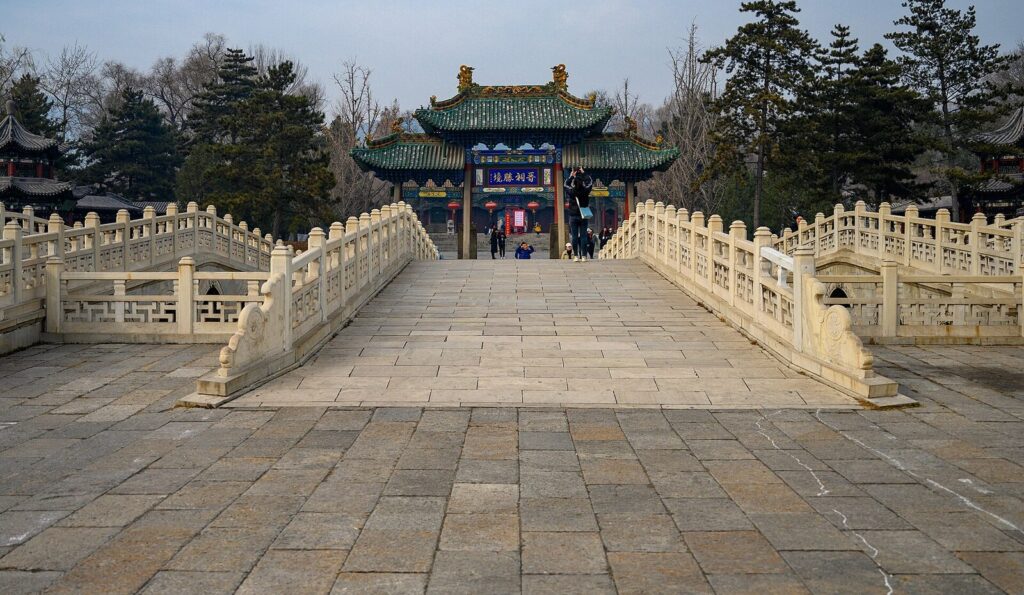
Jinci (晋祠) is the reason to come. Set against Xuanweng Mountain, it is a temple-and-garden complex that dates back more than a thousand years. The Hall of the Holy Mother (Shengmu Dian), built in the Northern Song around 1023–1032, holds painted clay attendant-maid statues, and the cross-shaped Flying Bridge crosses the fish pond in front. A 3,000-year-old “Zhou cypress” leans beside the hall.
| Item | Detail |
|---|---|
| Ticket | CNY 80 (US$11); half price CNY 40 for students and seniors with ID |
| Hours | Roughly 08:30–17:30; some sources report later summer hours |
| Reservation | Usually walk-up on normal days; book via official WeChat on public holidays |
| Time needed | 3–4 hours |
| Getting there | Bus from the city centre or DiDi, about 40 minutes |
Go first thing in the morning to beat tour buses. Spend the late morning in the main halls, the Nanlao Spring and the Flying Bridge, then eat nearby. If you still have energy, Tianlongshan Grottoes are a reported separate ticket (around CNY 50) and a joint ticket is offered; they are farther out, so only add them if you start early.
Return to the city by late afternoon. Keep the evening open for noodles and a final walk along the Fen River.
Two-day budget
| Item | CNY | USD (approx.) |
|---|---|---|
| Shanxi Museum | 0 | 0 |
| Twin Pagoda Temple | 30 | 4 |
| Jinci Temple | 80 | 11 |
| Food (2 days) | 120–300 | 17–42 |
| Metro, bus and DiDi | 60–120 | 8–17 |
| Mid-range hotel (per night) | 250–450 | 35–63 |
Prices are reported ranges and change often. Check on the day.
Onward routes
- Pingyao: about 31–40 minutes from Taiyuan South by high-speed train, with second-class fares around CNY 28–35 (US$4–5). See our Pingyao guide.
- Datong: about 1.5 hours by fast train, for the Yungang Grottoes.
- Mount Wutai: a coach or train-plus-bus journey of several hours; see Mount Wutai.
Best time to visit
April to October is the most comfortable window, with May to September the greenest. Winters are cold and dry; see our winter travel guide. Avoid national holidays, when Jinci and the museum are crowded.
FAQ
Can foreigners enter the Shanxi Museum?
Yes. Entry is free, but you book through the museum’s official WeChat account with your passport and bring the original. Reports say slots go quickly on weekends.
Is Taiyuan better as a base for Pingyao?
Often yes for budget and train choice, but staying a night inside Pingyao’s walls gives a very different atmosphere. Many travellers do both.
Do I need Chinese apps?
Alipay or WeChat Pay and a translation app make everything easier, especially for museum booking and DiDi.
Which day should I avoid?
Mondays, when the Shanxi Museum is usually closed.