
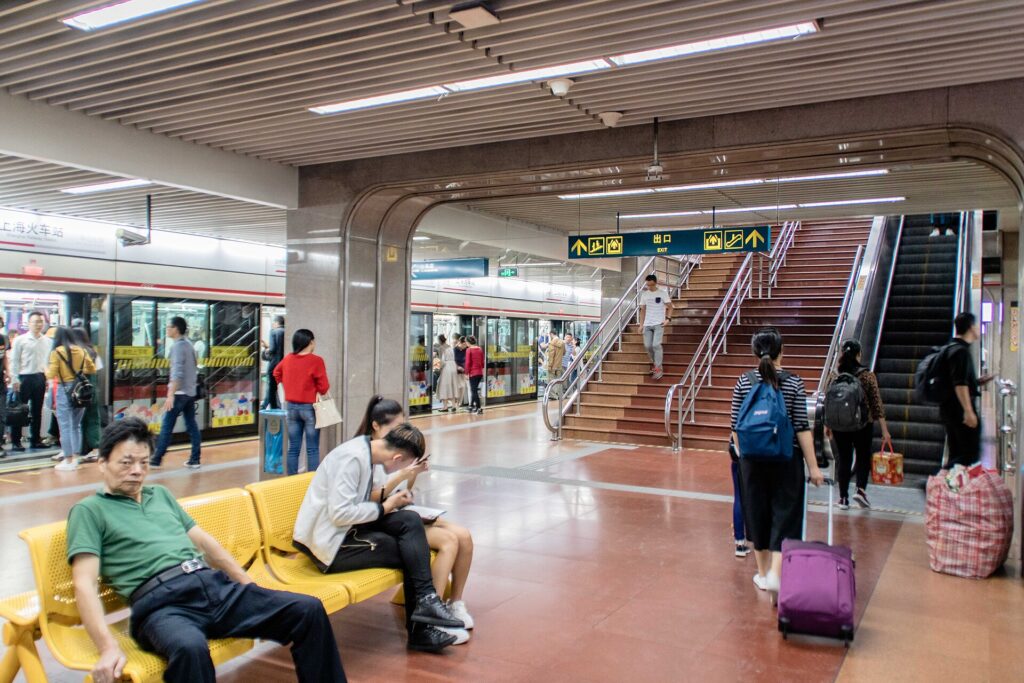
China’s metro systems are the best way for a first-time visitor to get around the big cities. They are clean, fast, fully signed in English, and cheap: most rides across town cost less than a coffee back home. Trains run every few minutes, they ignore traffic, and they reach almost every sight on a typical itinerary. The only hard part is paying — and in 2026 that has become much easier than it used to be.
This guide covers the three ways to pay, what a ride costs in Beijing, Shanghai and Chengdu, and the mistakes that catch first-timers out. If you are still planning the trip, our first-timer’s guide and itemised budget will help you put it together.
The three ways to pay
Every metro in China accepts the same three payment methods; which one works best depends on the city.
1. Tap your own contactless card
This is the newest option, and the simplest. In Beijing, Shanghai, Guangzhou and Chengdu, the fare gates now accept contactless bank cards — UnionPay, Visa, Mastercard and American Express, plus JCB in Shanghai. You tap the same card on entry and on exit, and the distance fare is worked out automatically. Beijing has accepted overseas Visa and Mastercard since September 2024, Shanghai across its whole network since 28 June 2025, and Chengdu since 28 July 2025.
Two conditions to check before you rely on this. First, the card must be a contactless chip card — chip-insert-only cards will not open a gate. Second, small-amount no-PIN contactless payments need to be switched on with your bank, and some overseas banks decline the first transit tap abroad. Keep Alipay ready as a backup on your first ride.
2. The Alipay or WeChat ride code
This is the method most visitors end up using, because it works in almost every Chinese city with a metro — all 55 mainland cities that have one, according to the Ministry of Commerce’s 2026 guide for foreign visitors. Inside Alipay, open the Transport (出行) section, choose the city, and activate that city’s metro ride code (乘车码, chéngchē mǎ). Scan the code at the gate on entry and again on exit; the fare is deducted from the card linked to Alipay. WeChat has an equivalent ride code through its metro mini-programs.
Three rules that trip people up. First, the ride code is not the ordinary blue payment QR code — that one will not open a gate. Second, the code is city-specific: when you move to a new city, switch the city and activate that city’s code. Third, it is one code per person, and a screenshot of a live code is not a valid ticket, so open it before you reach the gate — underground, your phone may have no data. Set Alipay up and link your foreign card before you fly; our payment guide walks through the setup, and it is the same account that pays for taxis, food and attraction tickets.
3. A single-journey ticket or a transport card
The dependable fallback. Every station has ticket machines with an English menu; tap your destination on the screen, pay with cash (¥5 and ¥10 notes), Alipay or WeChat Pay, and collect a token or paper ticket. Single-journey tickets are valid only on the day of purchase and are collected at the exit gate. If you would rather not rely on a phone at all, each city sells a physical stored-value transport card at station service counters — Shanghai’s costs a ¥20 refundable deposit plus whatever you load, and Chengdu’s Tianfu Tong (天府通) card works the same way and also covers buses. The fare is identical whichever method you pick, so this is a convenience decision, not a cost one.
What a ride costs, city by city
Fares are distance-based everywhere, and they have barely moved in years. A day of sightseeing by metro usually totals ¥15–25 per person.
| City | Starting fare | Typical tourist ride | Hours |
|---|---|---|---|
| Beijing | ¥3 for up to 6 km, then +¥1 per distance band, up to about ¥10 | ¥3–6 | About 05:00–23:30, varies by line |
| Shanghai | ¥3 for up to 6 km, then +¥1 per 10 km | ¥3–5; Pudong Airport to the centre about ¥8 | About 05:30–23:00, last trains vary |
| Chengdu | ¥2 for the first 4 km, rising in bands to about ¥9 | ¥2–5 | About 06:00–23:00, varies by line |
A few details worth knowing. In Beijing, a ticket is valid for four hours from first validation; stay inside the system longer and you pay a surcharge. Chengdu has the same four-hour rule, and going over it means paying the highest single fare from your exit station. Shanghai also sells a one-day pass for ¥18 and a three-day pass for ¥45 at station service desks. One caution: Shanghai held a public hearing on a fare change in September 2026, so check the current fares on official Shanghai Metro channels before you travel.
Your first ride, step by step
Security first. Every metro station has an airport-style bag X-ray at the entrance. Put your bag on the belt, walk through the metal detector, and collect your things — allow one to three minutes off-peak, five to eight in the rush hour.
Follow the English. Station names, line numbers, direction signs and exit letters are all bilingual. The direction that matters is the terminus station in the direction you are travelling — that is how platforms are signed, not “northbound” or “southbound”.
Transfers are free. Switching lines inside a station costs nothing extra; your fare is calculated on exit from the total distance travelled. Follow the coloured transfer signs and allow five to ten minutes for a busy interchange.
Mind the exits. Big stations have exits labelled A, B, C, D and beyond, and the wrong one can put you a ten-minute walk from where you want to be. Check the exit map on the platform before you get off, and note the exit letter in your map app.
Watch the last train. This is the mistake that costs visitors a taxi fare at midnight. Most lines stop running between 22:30 and 23:30, and each line has its own last train. Check the last-train time on the station board or in Amap before a late dinner, and have DiDi ready as a backup.
Getting to and from the airports
The metro is the cheapest airport transfer in every major city, and usually the fastest in traffic. A few numbers to plan around:
- Beijing Capital (PEK): the Capital Airport Express is a flat ¥25 to Dongzhimen in the centre, running roughly 06:00–23:00. From Daxing (PKX), the Daxing Airport Express is ¥35 regular or ¥50 business class to Caoqiao, where you change onto the regular metro.
- Shanghai Pudong (PVG): Line 2 runs into the centre for about ¥8 and takes around an hour. The Maglev is the famous alternative — ¥50 one-way, ¥80 return valid seven days, to Longyang Road in about eight minutes, where you change to Line 2. Show a same-day flight ticket at the counter for a ¥40 single fare.
- Chengdu Tianfu (TFU): Line 18 connects the airport to the city in 40–60 minutes for roughly ¥10–15.
For the full door-to-door picture, see our airport arrival guide.
Four mistakes first-timers make
1. Using the wrong QR code. The ordinary Alipay payment code does not open a metro gate. You need the dedicated transit code from the Transport section, and the right city’s version of it.
2. One code for two people. Each traveller needs their own ride code or card. A couple sharing one phone will find the second person stuck at the gate.
3. Riding into the rush hour unprepared. Weekday peaks run roughly 07:30–09:30 and 17:30–19:30, and Lines 1, 5 and 10 in Beijing and Lines 1 and 2 in Shanghai are genuinely crowded. Plan sightseeing for mid-morning and early afternoon.
4. Bringing big luggage at peak times. There are no luggage racks, escalators are crowded, and some older stations have stairs at the exit. If you are travelling with suitcases, ride outside peak hours, or take a DiDi to the station and the metro from there.
Metro, taxi or walking?
Use the metro for almost everything in Beijing, Shanghai and Chengdu — it is faster than a taxi in daytime traffic and costs a fraction of the price. Use DiDi for the first and last mile: to the station with luggage, home after the last train, or to sights the metro does not reach, like the Mutianyu Great Wall or the Chengdu Panda Base at opening time. And walk the old centres — the hutongs around Houhai in Beijing, the Bund and the French Concession in Shanghai, the lanes of Kuanzhai Alley in Chengdu — because that is where the city actually happens. Our Beijing and Shanghai itineraries are built around exactly this mix.
Once you have ridden the metro once, the whole country opens up: the same Alipay ride code works on buses, the same logic applies in Xi’an, Chongqing, Guangzhou and Hangzhou, and the same cheap fares make a two-week trip far less expensive than most visitors expect. Get the payment sorted before you fly, learn the two or three lines your hotel sits on, and the metro will quietly become the easiest part of your trip.
Want your days planned around the metro map instead of taxi queues? Our concierge service builds your route station by station, so you always know which line, which exit and which last train. Want this trip tailored to your dates? Our Route Design ($180) turns it into a day-by-day plan.