
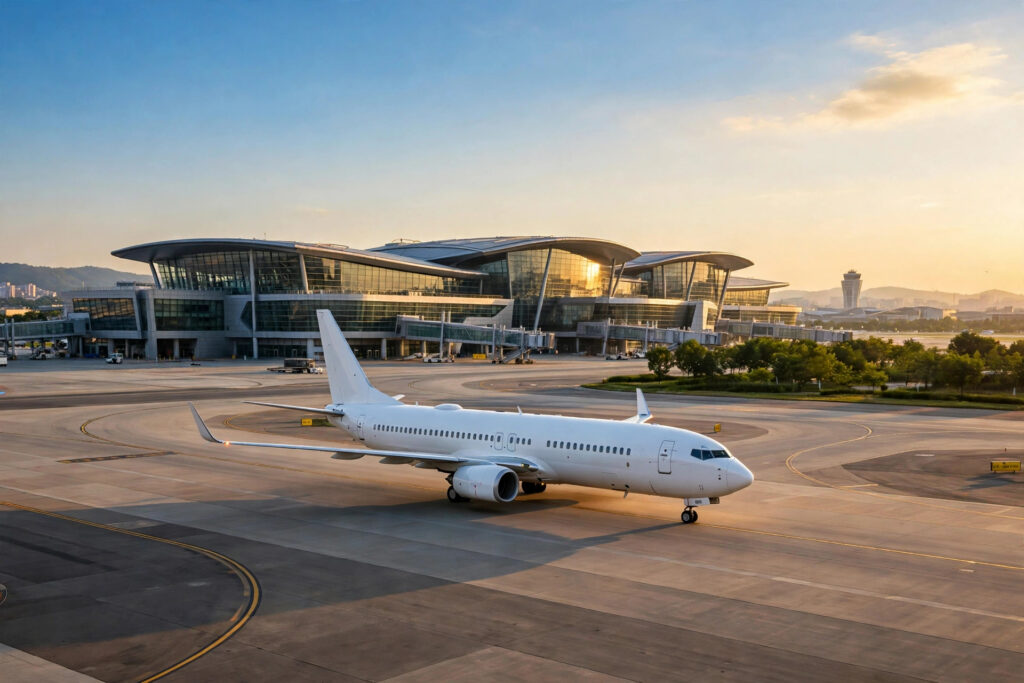
China is enormous — roughly the size of Europe — and the high-speed train, brilliant as it is, cannot cover every distance sensibly. Beijing to Chengdu is 1,800 kilometres: a twelve-hour train ride or a three-hour flight. Sooner or later, most first-time visitors end up on a domestic flight, and the system works differently enough from flying at home that a little preparation saves real money and real stress. This guide covers how to book, what your ticket actually includes, what happens at the airport, and how to decide between flying and taking the train.
Which airlines fly inside China?
China has three big full-service carriers — Air China, China Southern and China Eastern — plus strong regionals such as Hainan Airlines, Sichuan Airlines and XiamenAir. Between them they cover every city you are likely to visit, and their service is closer to a European flag carrier than to a budget airline: a free checked bag, a snack or a meal on longer routes, and proper customer service in English.
Then there are the budget carriers, led by Spring Airlines, plus Juneyao Air, 9 Air, Lucky Air and West Air. Their headline fares look startlingly cheap — sometimes under ¥200 for a two-hour flight — but the cheap fare buys you very little beyond the seat itself.
How to book a domestic flight as a foreigner
Use Trip.com. It is the simplest route for visitors: the English site and app accept foreign bank cards, show you the baggage allowance for each fare before you pay, and let you manage changes and refunds without a Chinese phone number. Airline websites and apps work too, but many still expect WeChat Pay, Alipay or a Chinese bank card, and their English versions can be patchy.
Every domestic ticket in China is booked under real-name registration: you enter your full name exactly as it appears in your passport, plus your passport number. This is not a formality. The name on the booking is checked against your passport at check-in and again at security, and a mismatch — a missing middle name, a different spelling — can stop you boarding. Book with the same spelling every time, and carry the same passport you booked with.
As for price, domestic fares in China are genuinely reasonable. Booked a few weeks ahead, typical one-way economy fares look roughly like this: Beijing to Xi’an, ¥400–900; Beijing to Shanghai, ¥500–1,000; Shanghai to Chengdu, ¥600–1,200. Fares move with demand, so treat these as a guide rather than a promise, and check the current price before you commit. The cheapest fares usually appear three to six weeks before departure. One warning: the cheapest fare class is often non-refundable and non-changeable, so read the fare rules before you click buy — a ¥300 saving is poor value if your plans shift and the ticket is worth nothing.
At the airport: what actually happens
Arrive two hours before departure: check-in usually closes 30–45 minutes before take-off, and security queues can be slow at peak times. You do not need a paper ticket — your passport is your ticket. At the check-in desk or a self-service kiosk, your passport number pulls up the booking, and many airports let you check in on the airline’s app and walk straight to security with a QR code.
Security in China is thorough and has a few rules that catch visitors out. Liquids in hand luggage follow the familiar 100 ml limit. Power banks must go in your hand luggage, never in checked bags, and only those under 100Wh are accepted without question; larger ones need the airline’s approval, and anything over 160Wh is banned outright. And unlike in most countries, lighters and matches are banned entirely — not just in the cabin, but in checked luggage too. Leave them at the hotel.
Boarding usually starts 30–40 minutes before departure, and gates can change with little warning, so keep an eye on the departure boards. Announcements in English are made at the larger airports, but the screens are your most reliable source.
Baggage: what you actually get for free
There is no single national allowance — each airline sets its own — so always check the allowance shown on your booking. The pattern for the big carriers is consistent:
| Airline / fare | Free checked baggage (economy) | Free hand luggage |
|---|---|---|
| Air China, domestic economy | 20 kg | 1 piece, 5 kg, 55 × 40 × 20 cm |
| China Southern, domestic economy | 20 kg | 1 piece, 8 kg, 55 × 40 × 20 cm |
| China Eastern, domestic economy | 20 kg | 1 piece, 8 kg |
| Spring Airlines, cheapest fare | None — buy it separately | 1 piece, 7 kg, 40 × 30 × 20 cm |
Two things deserve emphasis. First, Spring’s free hand-luggage allowance is genuinely small — 40 × 30 × 20 cm is closer to a large handbag than a cabin bag — and an oversized bag at the gate costs ¥300 per piece on domestic routes. If you fly Spring, measure your bag before you leave the hotel, and buy any checked baggage online in advance: it is always cheaper than at the airport. Second, some China Southern fares now include no free checked bag at all, so the headline allowance in a table like this is no substitute for reading what your own ticket says.
Which airport are you actually flying from?
Several Chinese cities have two airports, and arriving at the wrong one is a mistake you only make once:
- Beijing: Capital (PEK), north-east of the city, served by the Airport Express metro line; and Daxing (PKX), south of the city, about an hour by metro or express train. Air China is mostly at PEK; China Southern is at PKX.
- Shanghai: Hongqiao (SHA), close to the city centre and on metro lines 2 and 10, handles mostly domestic flights; Pudong (PVG), an hour east, handles international flights plus some domestic ones.
- Chengdu: the new Tianfu Airport (TFU) now takes most flights, while Shuangliu (CTU) still handles some domestic routes. The two are on opposite sides of the city — check your ticket.
When you land, the metro is usually the fastest and cheapest way into town, and every major airport has clear English signage. If you are arriving late at night, check the last metro time before you fly; otherwise have DiDi ready on your phone. Our airport arrival guide for Shanghai and Beijing walks through the landing process step by step.
Train or plane? The five-hour rule
China’s high-speed rail is so good that flying is not always the faster option. A useful rule of thumb: if the train takes under five hours, take the train. Stations sit in the city centre, you arrive 30 minutes before departure instead of two hours, and there are no baggage fees or liquid rules. Beijing to Xi’an is the classic example — the train takes four and a half to six hours, the flight takes two, but by the time you add the airport journey, the two-hour buffer and the baggage reclaim, the difference shrinks to almost nothing.
Above five hours, the plane usually wins. Shanghai to Chengdu is twelve hours or more by train against a two-and-a-half-hour flight. Beijing to Guangzhou, Kunming or Urumqi are all flights, no contest. Our China high-speed rail guide explains the train side in detail, including how to book with a passport.
Delays happen — plan for them
Chinese domestic flights are delayed more often than visitors expect, usually by weather or air-traffic congestion around the big hubs. A one-hour delay is common enough that you should never book a tight connection on separate tickets, and never schedule something unmissable — a tour departure, a train connection, a hotel check-in deadline — within three hours of landing.
If your flight is delayed, the airline’s app is the fastest source of updates. For a cancellation, go to the airline’s service desk: full-service carriers will rebook you onto the next available flight, and on longer delays they generally provide a meal and, if you are stuck overnight, a hotel. Keep your boarding pass and receipts for any claim.
A quick checklist before you book
- Book on Trip.com unless you have a specific reason not to, and pay with a foreign card that works in China — see our guide to paying in China if you are still setting up WeChat Pay or Alipay.
- Enter your name exactly as printed in your passport, and bring that same passport to the airport.
- Read the fare rules: the cheapest ticket is often non-refundable, and the baggage allowance shown on your booking is the only one that counts.
- Check which airport you are flying from — and to. In Beijing, Shanghai and Chengdu the wrong airport can cost you an hour and a missed flight.
- Put power banks and liquids in your hand luggage, leave lighters behind, and arrive two hours early.
- Compare the train before you fly: under five hours on the rails, the train usually wins.
Flying inside China is straightforward once you know the three things that differ from home: everything is booked against your passport, the baggage rules change from airline to airline, and the airport you fly from matters as much as the flight itself.
Still working out how flights, trains and hotels fit together across your trip? That is exactly what our concierge service is for. Want this route tailored to your dates? Our Route Design ($180) turns your rough plan into a day-by-day itinerary — flights, trains, hotels and all, in the order that actually works.