
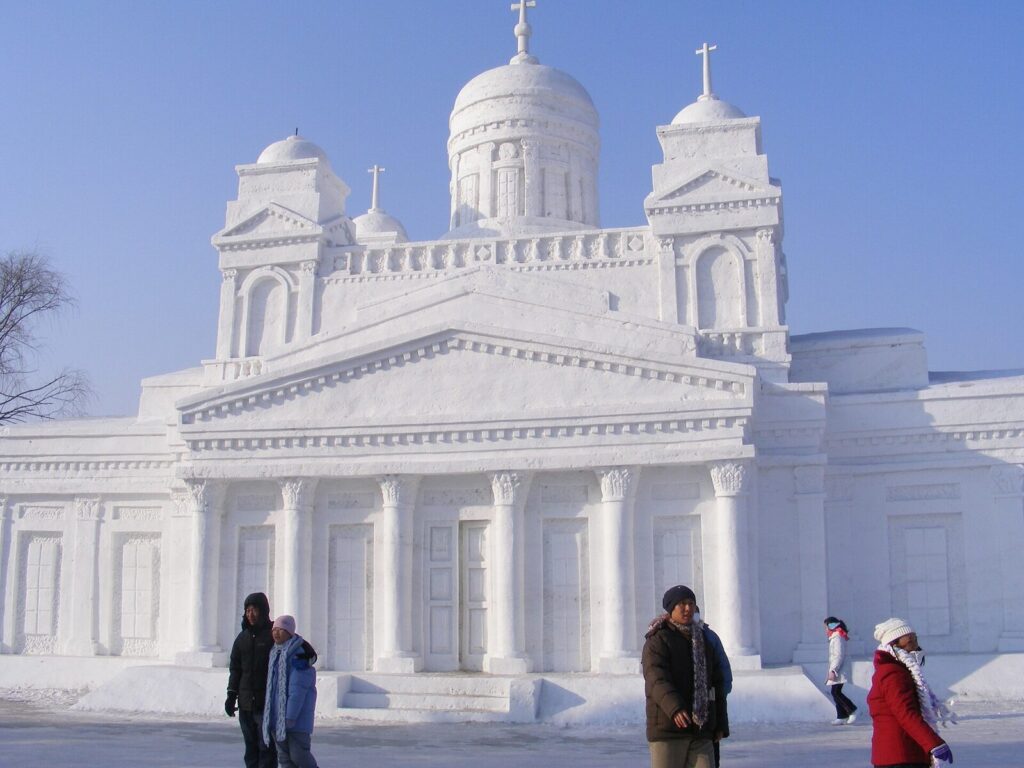
Winter is the season most first-time visitors to China rule out — and that is exactly why it can be the best time to go. The summer crowds are gone, the air in the north is crisp and clear, hotel prices in most cities drop, and China in winter is not one experience but three: deep cold and ice sculpture in the far north, bright, dry sightseeing days in Beijing and Xi’an, and warm beach weather in the far south. The trick is knowing which China you are visiting.
This guide covers where to go in winter, what it costs, and the one surprise that catches more visitors than the cold itself: the heating. Read it alongside our month-by-month guide to the best time to visit China and our first-timer packing list, and you will have the seasonal picture covered.
The one thing to understand first: the heating line
China is divided by an invisible heating line, roughly along the Qinling Mountains and the Huai River. North of it, cities have central district heating. South of it, most buildings do not. That single fact shapes winter travel more than the temperature outside.
In Beijing, Tianjin and Xi’an, the official heating season runs from 15 November to 15 March, and cities can bring it forward or extend it in unusually cold weather. Once it is on, northern hotels and restaurants are genuinely warm — often warmer than you expect. Before 15 November, hotels rely on air conditioning in heating mode, which is weaker, so pack one extra warm layer for the room if you travel in early November.
South of the line, the surprise runs the other way. Shanghai, Hangzhou and Suzhou can be damp and chilly in January, yet many hotels and restaurants have no central heating at all, only wall-mounted air conditioners. A room can feel colder inside than outside on a sunny afternoon. When you book in the south in winter, check reviews for heating, ask the hotel directly, and pack a warm layer you can wear indoors.
Where to go in winter: three trips in one country
1. For the full winter spectacle: Harbin
If you want winter at its most dramatic, go to Harbin in Heilongjiang province, in the far north-east. The Harbin International Ice and Snow Festival traditionally opens on 5 January, and its flagship venue, Ice and Snow World, typically runs from late December to late February. Expect vast illuminated ice buildings, giant snow sculptures, ice slides, and temperatures that regularly sit well below freezing — January days around -15°C are normal, and colder snaps go far lower.
Plan around the dates, not just the festival name. The city festival, Ice and Snow World and the Sun Island snow sculpture expo do not all open on the same day, and 2027 opening dates and ticket prices for the new season had not all been confirmed at the time of writing — check before booking. As a budget reference, the previous season’s standard adult ticket for Ice and Snow World was ¥328, with Sun Island around ¥198. Our detailed Harbin Ice Festival 2027 guide covers venues, tickets and cold-weather kit in full.
Harbin rewards a short, focused visit: two to three nights is plenty. Bring winter boots with grip, a windproof outer layer, thermal base layers and phone-friendly gloves, and keep your phone warm in an inside pocket, because batteries drain fast in extreme cold. Book hotels and trains early for January weekends.
2. For classic sightseeing without the crowds: Beijing and Xi’an
For most first-timers, the best winter trip is the classic one, done quietly. Beijing in December and January is cold — often around freezing — but usually dry and sunny, with clear skies that summer haze rarely allows. The Great Wall in winter, with snow on the stones and almost no queues, is a different experience from the summer version, and the Forbidden City and the Temple of Heaven are far easier to enjoy without crowds. Xi’an is a few degrees milder, and its city wall, Muslim Quarter and Terracotta Army are all comfortable winter visits, with the added advantage that northern heating keeps hotels and restaurants warm.
Winter also changes the pace in a good way: museums, temples and restaurants have space, and you can linger instead of shuffling through crowds. Plan outdoor sights for late morning and early afternoon, and keep evenings for food and teahouses. If you are comparing cities, our itemised China trip budget will help you compare what a winter week actually costs.
3. For escaping winter altogether: Sanya and Kunming
If your idea of a winter holiday is warmth, skip the north entirely and head south. Sanya, at the southern tip of Hainan Island, has no real winter: January daytime temperatures typically sit in the mid-20s Celsius, the sea stays warm enough for swimming, and rainfall is at its lowest. It is peak season there, so book early and expect higher hotel prices than in summer — the trade-off for guaranteed warmth.
Kunming, the capital of Yunnan, is the gentler alternative. Its January average is around 9.5°C, with sunny days reaching about 16°C and nights dropping to around 3°C. It is pleasant walking weather, and it pairs well with the old towns of Yunnan. Pack for a big day-to-night swing: a warm jacket for the evening, lighter layers for midday sun.
Dates to plan around
Two winter dates matter more than any others. The first is Chinese New Year, which falls on 6 February 2027. The week around it is the busiest domestic travel period of the year: trains sell out, flights and hotels cost more, and some smaller attractions and restaurants close for a few days. If you can, travel in December or early January instead. Our Chinese New Year 2027 guide explains closures and transport in detail.
The second is the Harbin peak. The best window for the ice festival is roughly mid-January, after construction is finished and before the New Year crowds arrive. Late December can work too, but check whether every venue is open before you book flights, since opening dates vary by venue. For the rest of the country, December is generally the sweet spot: winter atmosphere, low crowds, and prices before the holiday surge.
What winter costs
Winter is usually cheaper than spring and autumn, with two exceptions: Harbin in January and Sanya in January and February, where peak demand pushes prices up. Elsewhere, hotels in Beijing, Xi’an and Shanghai often discount in winter, and flights from abroad can be noticeably cheaper than in cherry-blossom or Golden Week season.
Budget for winter-specific costs too. In Harbin, set aside roughly ¥330 for Ice and Snow World as a planning figure, plus a second venue for the snow sculptures. In the south, the extra cost is the room: a hotel with reliable heating is worth paying a little more for. And everywhere in winter, keep a small reserve for a taxi when the cold makes walking unappealing; ride-hailing in China is inexpensive by international standards.
Staying warm: the practical checklist
Dress in layers you can adjust, not one enormous coat. A thermal base layer, a warm mid-layer such as fleece or light down, and a windproof outer shell covers everything from a Beijing afternoon to a Harbin evening, with a heavier down jacket added for the far north. Waterproof boots with grip matter more than fashionable ones: ice, slush and polished stone steps are a real slipping hazard, especially at the Great Wall and in Harbin.
Protect the small things. A hat that covers your ears and a scarf you can pull up over your face make the difference between enjoying an hour outside and retreating after twenty minutes. Carry hand warmers for Harbin — they are sold cheaply in local shops — and keep your phone and power bank in an inside pocket.
Eat and drink for the weather. Northern winter food is built for cold days: hotpot, dumplings and noodles in broth. In the south, winter brings fresh seafood in Sanya and warming mushroom hotpot in Yunnan. Our first-timer food guide covers ordering and prices.
Getting around in winter
China’s high-speed rail is the winter traveller’s best friend: trains are frequent, punctual and warm, and they keep running in weather that would ground flights. Book the busiest routes early around New Year, and allow extra time at northern airports, where snow can delay flights even when trains run normally. Our high-speed rail guide explains seat classes and booking.
Within cities, the metro is warm and cheap, and ride-hailing fills the gap on the coldest nights. Plan shorter outdoor stretches than you would in spring, with a warm stop — a teahouse, a museum, a noodle shop — built into every route.
The bottom line
Do not let winter put you off China, but do not treat it as one season either. Choose your winter: ice and spectacle in Harbin, quiet classics in Beijing and Xi’an, or warmth in Sanya and Kunming. Check the heating where you stay, especially in the south. Book early for Harbin in January and for anywhere over Chinese New Year. And pack for the indoors as carefully as for the outdoors — in China in winter, the room you sleep in matters as much as the weather outside it.
If you would like help shaping a winter trip around your dates, our concierge service can do the detailed planning for you. Want a winter route tailored to your dates? Our Route Design ($180) turns it into a day-by-day plan.