
Last updated: November 17, 2026
Fuzhou is the city many first-time visitors skip on the way between Xiamen and Hangzhou or Shanghai. That is a shame. It has one of the best-preserved Ming and Qing old quarters in southern China, a mountain temple a short ride from downtown, banyan-lined streets, hot springs under the city, and its own distinct cuisine. It is also far less crowded than Xiamen or Hangzhou. This guide gives you a realistic two-day plan, ticket prices, transport, food and the practical details foreigners tend to trip over.
Fuzhou at a glance
| Topic | What to know |
|---|---|
| Best for | History lovers, slow walkers, food fans, travelers linking Xiamen, Wuyi Mountain and the Yangtze Delta |
| Time needed | 2 days (1 if you are only passing through; a 3rd day adds Mawei or hot springs) |
| Best seasons | Oct–Dec and Mar–Apr; summers are hot, humid and typhoon-prone (July–September) |
| Main stations | Fuzhou Station (north side) and Fuzhou South (south side), linked by Metro Line 1 |
| Budget | Roughly ¥350–600 (US$50–85) a day for a mid-range traveler including hotel |
Getting to Fuzhou
By high-speed rail
Fuzhou sits on the coastal high-speed line. Typical journeys: Xiamen about 1 to 1.5 hours (the fastest trains to Fuzhou South take under an hour; schedules list dozens of departures a day), Quanzhou around 40 minutes, Hangzhou around 3 hours, Shanghai around 4 hours. Pick your station by hotel: Fuzhou Station is on the north side of the city, Fuzhou South on the south side. Foreigners can book on the 12306 app or Trip.com using a passport; see our domestic transport guide and the passport-gate tips in our ticket booking guide.
By air
Fuzhou Changle International Airport (FOC) is about 45 km from the center. Airport buses and taxis/ride-hailing run into town; allow roughly an hour. Expect a ride-hail fare in the range of ¥100–150 (about US$14–21); confirm in your app. Our essential apps guide covers DiDi and Alipay set-up.
Getting around
- Metro: Line 1 runs north–south through the center and connects both rail stations; Line 2 crosses east–west. Scan the Alipay or Metro app code, or buy a single-journey token. See how to use the metro in China.
- Ride-hailing: DiDi works in English and is the easiest way to reach Gushan.
- On foot: the old quarter, Nanhou Street and Lin Zexu’s memorial hall are all within a short walk of each other.
Where to stay
Stay near Sanfang Qixiang or along Metro Line 1 around Dongjiekou and Nanhou Street. You can walk to the lanes, find food at night, and ride the metro to either rail station. If you arrive late on a train, staying near Fuzhou South saves a transfer, but you lose the evening atmosphere of the old town. Remember that hotels must register foreign guests; read our visa guide for entry requirements and keep your passport handy at check-in.
Day 1: Sanfang Qixiang and the old city
Morning: Three Lanes and Seven Alleys (三坊七巷)
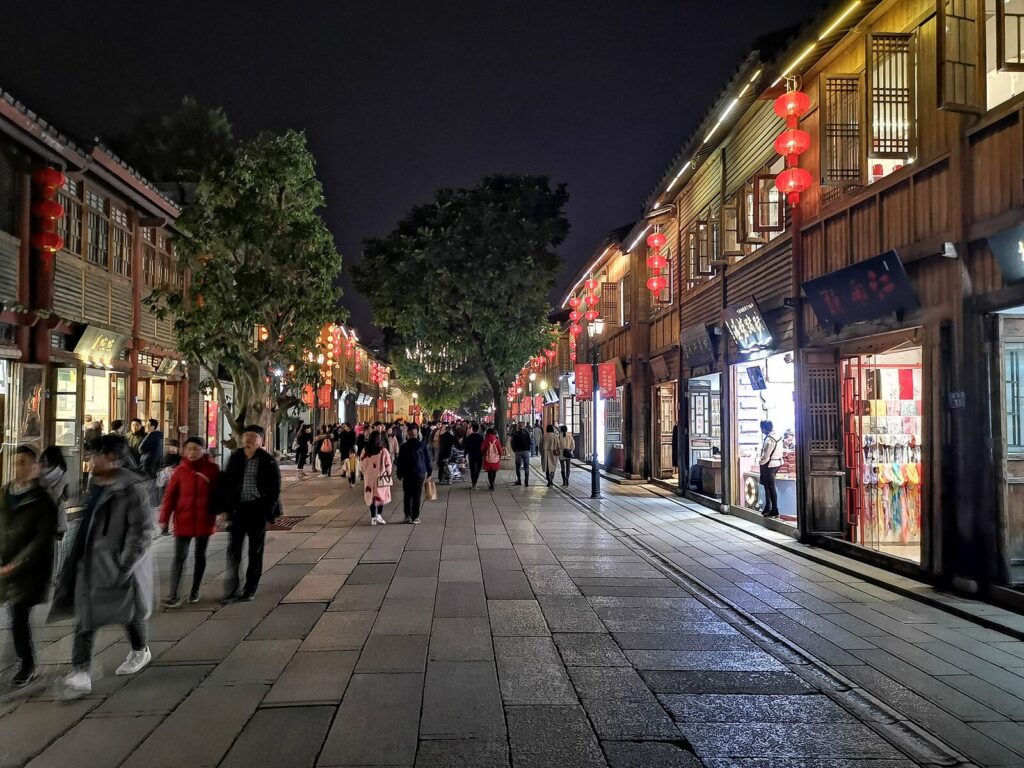
This 40-hectare quarter in the heart of Fuzhou preserves courtyard homes of officials, scholars and reformers, with white walls, horse-head gables and carved wooden halls. The streets themselves are free and open to walk in; you do not need to book to stroll. A few restored houses charge admission. Published rates (effective May 2025) are:
| Site | Ticket |
|---|---|
| Combined ticket, five paid houses | ¥70 (about US$10) |
| Little Yellow House (Xiaohuanglou) | ¥20 |
| Shuixie Stage (Water Pavilion) | ¥20 |
| Yan Fu’s Former Residence | ¥15 |
| Liu Family Compound | ¥15 |
| Guo Baiyin’s Former Residence | ¥10 |
| Several other houses (Lin Congyi Residence, Xie Family Ancestral Hall and more) | Free |
The combined ticket is only worth it if you plan to enter at least four of the paid houses. If you just want the atmosphere, the free houses and the lanes give you most of the experience. Plan 2 to 3 hours. Bring your passport in case a gate asks for real-name registration.
Lunch: Fuzhou classics
Try fish balls (鱼丸) with pork filling, yanpi (肉燕, pork-paste wrappers in soup), oyster cakes and dingbianhu (锅边糊, rice-batter soup). The banquet dish Buddha Jumps Over the Wall (佛跳墙) is a rich, slow-cooked pot of seafood and meat; it is pricey, so ask the price before ordering. Our China food guide explains how to order when you cannot read the menu.
Afternoon: Lin Zexu memorial and Nanhou Street
The Lin Zexu Memorial Hall, dedicated to the Qing official who destroyed opium in 1839, is free and sits just north of the lanes. Afterwards, walk Nanhou Street, a lively pedestrian lane with snacks and souvenirs. It is touristy but handy for a coffee break.
Evening: lanes at night, then hot spring
The old quarter is lit up after dark and feels quieter and more atmospheric. Fuzhou is also a hot-spring city, with spa parks and bathhouses in the center. Entry is commonly quoted at about ¥88–150 (US$12–21) depending on the venue; confirm price and swimsuit rules at the door.
Day 2: Gushan mountain and Yongquan Temple
Morning: ride to Gushan (鼓山)
Gushan rises on the eastern edge of the city, roughly 11 km from the center. Take a DiDi to the foot of the mountain, which is simplest. The Eighteen Sights park entry is about ¥10 (students ¥5). The cable car costs ¥70 return or ¥50 one way for adults (children 1.25–1.4 m ¥35 return; under 1.25 m free). Walkers can take the historic path up, which is steep in parts and slippery after rain. Operators can change cable car direction or close it in bad weather, so check the notice at the base before you commit.
Late morning: Yongquan Temple (涌泉寺)
Founded over a thousand years ago, this active Buddhist temple is known for its halls, stone inscriptions and a long tradition of printing sutras. Dress modestly, keep your voice low, do not photograph worshippers up close and ask before taking pictures inside halls. Vegetarian meals are commonly available nearby. Allow 1.5 to 2 hours at the temple.
Afternoon: Fujian Museum or Yantai Hill
Return to the city for the Fujian Museum near West Lake. Permanent galleries are free; some special exhibitions charge extra. Typical hours are Tuesday–Friday 09:00–18:00 (last entry 17:30) and weekends and holidays 09:00–20:00 (last entry 19:30), closed on Mondays except holidays. This is also your rainy-day replacement for Gushan. If you prefer the outdoors, wander Yantai Hill (烟台山), a hill of red-brick colonial-era houses and banyan trees south of the river, free to explore.
Evening: Shangxiahang or the Fudao
Shangxiahang, a restored merchant district by the river, has cafés and bars. The Fudao, an elevated forest walkway, is free and used daily by locals if you want a gentle walk.
Sample budget for two days
| Item | CNY | USD (approx.) |
|---|---|---|
| Hotel, mid-range, 1 night | 250–450 | 35–63 |
| Sanfang Qixiang combined ticket | 70 | 10 |
| Gushan park + cable car return | 80 | 11 |
| Local food, two days | 150–250 | 21–35 |
| Metro and DiDi | 60–120 | 8–17 |
USD figures are rounded at roughly ¥7.1 per US$1; exchange rates move.
Pros and cons of Fuzhou
Pros
- Authentic, lived-in old quarter with free access
- Fewer crowds than Xiamen or Hangzhou
- Good value for food and hotels
- Easy rail links to Wuyi Mountain, Xiamen and Shanghai
Cons
- Limited English signage outside tourist zones
- Summers are hot and humid, with typhoon risk
- Some sights are spread out; plan transport
Practical tips
- Carry your passport for hotels, trains and any real-name ticket gates.
- Set up Alipay or WeChat Pay before you arrive; see how to pay in China if you need the steps.
- Check the weather for Gushan, as clouds and rain can ruin the views and make paths slippery.
- Pair Fuzhou with Xiamen: see our Xiamen 2-day itinerary and the Gulangyu guide.
FAQ
Is two days enough for Fuzhou?
Yes, for the old quarter and Gushan. Add a third day for Mawei’s shipyard heritage or hot springs.
Do I need to book Sanfang Qixiang in advance?
The lanes are free and need no booking. Paid houses sell tickets at the gates and on booking platforms; bring your passport.
Which Fuzhou train station should I use?
Choose the one closest to your hotel. Fuzhou Station is north and Fuzhou South is south; Metro Line 1 links them.
Is Fuzhou good in winter?
Winters are mild compared with northern China, which makes Fuzhou a pleasant off-season stop. Pack a light jacket and umbrella.
Can I use English apps?
Yes. Trip.com for trains, DiDi for rides and Alipay for payments all work in English with a foreign passport or card.