
Last updated: November 15, 2026
Nanchang, the capital of Jiangxi, is known in China as the “Hero City” because the 1927 Nanchang Uprising began here. For travellers it is a quiet, affordable stop that most overseas visitors skip, which is part of its appeal. It also sits on the high-speed rail line to Jingdezhen’s porcelain, Lushan and Jiujiang, so it works well as a base in a longer Jiangxi trip.
Is Nanchang worth two days?
| Pros | Cons |
|---|---|
| Compact sights, mostly on one metro line | Hot, humid summers; best in spring and autumn |
| Free museum and free public squares | Real-name reservations at some sights are Chinese-first |
| Strong local food (fried rice noodles, spicy dishes) | Little English; translation and payment apps are essential |
| Easy rail links to Jingdezhen, Lushan, Jiujiang | Few big-name “wow” attractions compared with Xi’an or Beijing |
Getting to Nanchang and around
Nanchang has two main high-speed stations, Nanchang West and Nanchang East, plus Changbei International Airport on Metro Line 1. From Nanchang East, Jingdezhen North takes roughly 45–60 minutes, with second-class fares reported around CNY 86–94. Buy tickets with your passport; our guides to booking tickets in China and domestic flights explain how.
Metro Line 1 is the tourist line: Tengwangge, Wanshougong, Bayi Memorial and Bayi Square are all on it, and Line 3 reaches Shengjin Pagoda. Fares are distance-based, usually CNY 2–4 inside the centre. DiDi rides across town typically run CNY 15–30. See our China metro guide for QR-code payment.
Where to stay
Stay near Bayi Square or along Metro Line 1 around Wanshougong. You will be within a few stops of everything here. Choose a hotel that takes foreign passports; our hotel booking guide covers how to avoid a refusal at the desk.
Day 1: Tengwang Pavilion, Wanshou Palace and the river
Morning: Tengwang Pavilion (2–3 hours)
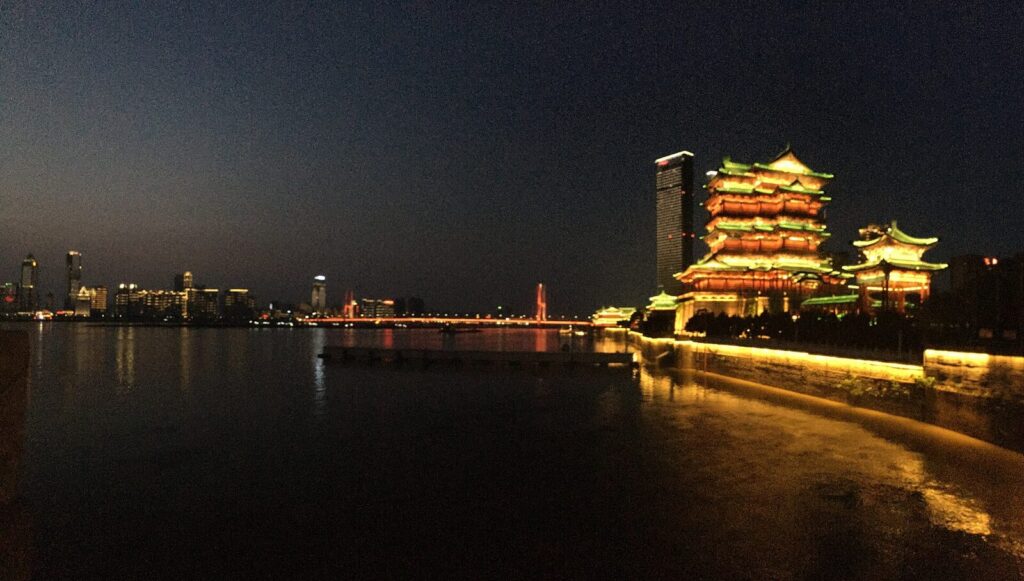
One of the “Three Great Towers” of southern China, Tengwang Pavilion was first built in AD 653 and has been rebuilt many times; the present nine-storey building dates from 1989. It is famous through Wang Bo’s Tang-dynasty preface. Take Metro Line 1 to Tengwangge and walk in.
- Ticket: about CNY 50 (US$7) for the paid core; most of the surrounding area is reported free. Evening shows are separate, reported around CNY 168.
- Reservations: sources disagree. Some report real-name entry since April 2026 through the official WeChat account, others say same-day tickets are fine. Ask your hotel to check, and bring your passport to scan at the gate.
- Tip: skip anyone selling “fast entry”; it queues like everyone else.
- Folklore: locals say reciting the full preface gets you in free. Do not count on it.
Lunch and Wanshou Palace
Walk or ride one stop to Wanshou Palace, a restored historic district of grey-tile lanes, lanterns and snack counters, free to wander. Try fried rice noodles (chao fen), a Nanchang staple, and “mixed noodles” served with a spicy sauce. Expect CNY 20–50 (US$3–7) a meal. Our China food guide helps with ordering.
Afternoon: Gan River walk
Stroll the riverside boardwalk. If you climb the pavilion late, aim for the golden hour; the climb closes around 18:00 in winter, so check the day’s closing time.
Evening: Qiushui Square fountains
Qiushui Square puts on a free water, light and music show, commonly around 19:30 for roughly 15 minutes. The Gan River skyline is the draw. Times can change by season.
Day 2: Museum, Bayi Square and Shengjin Pagoda
Morning: Jiangxi Provincial Museum (2–3 hours)
The museum is free and sits on the river’s west bank, reached via Metro Line 1 to Zhujianglu. Reports say individual visitors can enter without a reservation since September 2026 if they bring valid ID, with passport holders using a verification channel. Hours are generally Tuesday to Sunday, 09:00–17:00, with last entry about 16:00, and closed Mondays. Because this has changed recently, check the official account the day before.
Lunch
Try Jiangxi home cooking: pot-roasted dishes, lotus root soup and fiery stir-fries. Budget CNY 50–100 (US$7–14).
Afternoon: Bayi Square
Bayi Square, with the Nanchang Uprising Monument at its centre, is free and open all day. The monument is usually lit from about 19:00 to 22:30. The nearby Bayi Uprising Memorial requires advance booking and is closed Mondays, so check before planning it.
Late afternoon: Shengjin Pagoda
This seven-storey brick pagoda has Tang-dynasty origins and its present form dates from the 1700s. It sits in a pedestrian temple-market district. Admission is reported around CNY 20 (US$3), roughly 08:00–21:00. Take Metro Line 3.
Two-day budget
| Item | CNY | USD (approx.) |
|---|---|---|
| Tengwang Pavilion | 50 | 7 |
| Shengjin Pagoda | 20 | 3 |
| Museum, squares, Wanshou Palace | 0 | 0 |
| Food (2 days) | 150–300 | 21–42 |
| Metro and DiDi | 40–120 | 6–17 |
| Mid-range hotel (per night) | 250–450 | 35–63 |
Prices are reported ranges, not guarantees. Always check on the day.
Day trips and onward routes
- Jingdezhen: porcelain city about an hour by train; better as an overnight than a day trip.
- Lushan and Jiujiang: about an hour north by high-speed rail; see Mount Lu.
- Wuyuan and the Sanqing: for mountains, see Mount Sanqing.
Best time to visit
Spring and autumn are most comfortable. Summers are very hot, and winters are damp and cool. Avoid the national holidays when sights get crowded. See our winter travel guide for cold-season planning.
FAQ
Can foreigners use a passport to enter the sights?
Yes, passports are accepted at the gates, but online reservation flows can be Chinese-first. Ask your hotel to book, or buy at the ticket window.
Do I need Chinese apps?
Alipay or WeChat Pay with a foreign card makes life easier; see our essential apps guide.
Is two days too long?
Not if you enjoy food and relaxed city walks. Pair it with Jingdezhen or Lushan to build a fuller Jiangxi trip.
Which day should I avoid?
Mondays: the museum and the Uprising Memorial are generally closed.