
Last updated: November 20, 2026
Moving through China with a big suitcase is the part of the trip nobody photographs. Stairs at metro stations, a gap of six hours between hotel checkout and an evening train, a day trip that starts at a station you will not return to: all of these are solved by luggage storage. The good news is that China has more options than most countries, and they are cheap. The slightly harder news is that most are set up in Chinese, so it helps to know what to look for before you arrive.
This guide covers every realistic option, what each costs in 2026, how to use it as a foreigner, and when to ship bags ahead instead. Prices come from published station and airport rate sheets and recent travel-site checks, and they vary by city, so treat them as ranges and confirm the posted rate when you drop off.
Your options at a glance
| Option | Typical cost | Best for | Catch |
|---|---|---|---|
| Hotel front desk | Free for guests; about ¥10–30/day for non-guests | Early arrival, late checkout | Ask first for non-guests |
| Train station staffed counter | ¥10–40 per bag/day (about $1.40–5.60) | Day trips, long gaps between trains | Passport and receipt needed |
| Airport counter | ¥20–60 per bag/24 h (about $3–8) | Layovers, side trips | Rates differ by airport and bag size |
| Smart lockers (metro, malls, stations) | About ¥2–6/hour, daily cap ¥15–50 | A few hours in one district | Chinese-language screens; mobile payment |
| Partner shops and mini-program apps | About ¥10–30 per bag/day | Near tourist areas | Booking needed; hours vary |
| China Railway bag service | ¥68–98 per piece | Heavy bags between cities | Needs a train ticket; 35 km limit |
| Courier forwarding (e.g. SF Express) | Roughly ¥80–200 between cities | Multi-city trips with a daypack | Needs a receiving hotel and lead time |
Option 1: Your hotel (start here)
Almost every hotel will hold luggage for guests before check-in and after checkout, usually at no charge. Ask at the front desk and keep the claim tag. Two practical tips:
- Keep valuables, medication, chargers and your passport in your daypack. Hotel luggage rooms are generally fine, but they are not a safe.
- If you are moving to another city the same day, ask the desk how late they are staffed. Most big hotels are 24 hours; small guesthouses may not be.
Some hotels will also store bags for non-guests for a small fee, which is useful when you are staying across town. It is at the hotel’s discretion, so ask politely and offer to pay. Remember that hotels must register foreign guests, which is separate from storage; our accommodation registration guide explains that process.
Option 2: Train station luggage storage
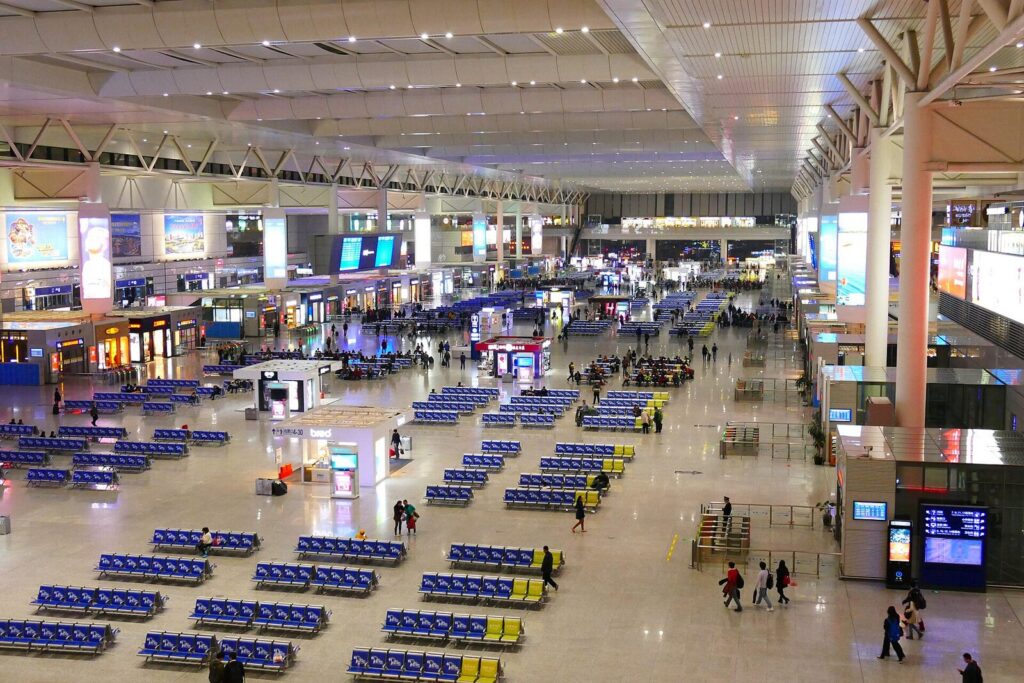
Look for the characters 行李寄存 or 小件寄存 (xíngli jìcún / xiǎojiàn jìcún). Big stations usually have a staffed counter and a bank of electronic lockers. For foreigners the staffed counter is the easier choice: the attendant tags the bag, checks your passport, hands you a receipt and quotes the price, so there is no screen to decode.
Published local rate sheets show how much it varies. Beijing’s station-area authority lists smart lockers around Beijing Railway Station at about ¥2–6 per hour with daily caps of roughly ¥20–48 depending on operator and locker size. Reviews of the Shanghai stations put staffed storage at about ¥15–35 per item. Smaller cities are often a flat ¥10.
How it works, step by step
- Drop bags before you pass security. Storage areas are normally outside the ticketed zone.
- Show your passport. Some counters also ask to see your train ticket, so keep your train booking handy.
- Pay by cash, Alipay or WeChat Pay. Our payment guide covers setting up the apps with a foreign card, and carrying a little cash is still wise.
- Photograph the receipt and note the closing time. Many counters close late evening, and a few close for a mid-day break.
- Collect with the receipt and the same passport.
Pros: central, cheap, staffed. Cons: queues at peak hours, size limits for very large or boxed items, and variable hours.
Option 3: Airport left-luggage
Major airports have staffed counters and lockers. Beijing Capital’s counters in Terminals 2 and 3 charge about ¥30–40 per rolling suitcase per 24 hours, ¥20–60 for cartons and other items, and ¥100 for oversized items; lockers in the parking buildings run about ¥20–50 a day. At Beijing Daxing, lockers in the airside area are capped at roughly ¥18–30 a day, and the city’s station-area guide lists staffed landside counters there as free at the time of its latest update, though you should confirm on arrival.
There is one genuinely valuable perk for transit passengers. Beijing Capital offers free storage of one piece for up to three days for travellers using the 240-hour visa-free transit policy, with the temporary entry permit issued at immigration. If you are on that route, read our China layover guide and our airport arrival guide first, and check the terms on the day because airports adjust such offers.
Option 4: Smart lockers, partner shops and apps
Metro stations, malls and tourist districts in big cities have self-service lockers billed by the hour and capped per day. They are fast but the interface is usually Chinese-only and requires Alipay or WeChat Pay. If you are fluent with translation tools, they are convenient for a few hours in one neighbourhood.
Mini-program platforms such as CunZhiJi list partner shops near stations and sights, typically ¥10–25 per bag per day, with small bags cheaper than suitcases. You book a date and size, and the shop holds your bag during its opening hours (often about 07:30–22:00). These work well in the old-town districts where lockers are scarce, but the booking flow is in Chinese, so expect to use the translate function in your camera or browser. Our essential apps guide lists the mini-programs worth setting up.
Museums, theme parks and many big attractions provide cloakrooms, free or for a modest fee. They close with the venue, so they are strictly same-day.
Option 5: China Railway’s bag service (for heavy bags)
If you are crossing China by high-speed rail with a large suitcase, there is a service worth knowing about. China Railway runs a door-to-station and station-to-door luggage service within about 35 km of the station, booked through 12306 for travellers who already hold a ticket. Reported pricing is per piece, not by weight: ¥68 per piece between an address and the station, and ¥98 per piece when delivered to or from the platform. The pickup leg is bookable from roughly 48 hours to 4 hours before departure.
It is currently Chinese-language and tied to 12306, so foreigners typically need the account already set up and verified. Coverage and stations differ, so check availability for your route before relying on it.
Good for: a hotel in a district far from the station, or a couple with two large cases. Skip if: your route is short or your hotel is a ten-minute walk from the platform.
Option 6: Forward your suitcase by courier
For a multi-city trip you can send your big bag ahead and travel with a daypack. Domestic couriers such as SF Express can collect from a hotel and deliver to the front desk of your next hotel. Published estimates run roughly ¥50–100 within a city and about ¥80–200 between cities, but quotes depend on billable weight (the greater of real and volumetric weight), declared value, packaging and remote-area surcharges, so there is no single price.
Checklist before you ship
- Ask the destination hotel in advance whether it accepts and stores parcels, and for how many days before arrival.
- Get both hotel names, addresses and phone numbers in Chinese characters.
- Put the guest name and arrival date on the parcel label.
- Remove batteries, power banks, liquids and anything restricted. Couriers inspect parcels and may refuse them.
- Keep passports, medication, electronics and one change of clothes with you.
- Keep the tracking number and allow a buffer day; delays happen.
Some destinations run their own schemes: Sanya’s tourism board, for example, lists a luggage delivery partnership with SF Express between the airport, railway station and more than 100 partner hotels. If you are visiting a resort city, ask your hotel what it offers.
Which option for which situation?
| Situation | Best choice |
|---|---|
| Arrive at 8 am, check-in is 3 pm | Hotel bag hold |
| Checkout at noon, train at 9 pm | Hotel hold, then taxi to station |
| Day trip from a base city | Leave bags at your hotel |
| 12-hour layover in Beijing | Airport counter, or free transit storage if eligible |
| Two big suitcases across three cities | China Railway bag service or courier forwarding |
| Hiking trip (e.g. Huangshan, Zhangjiajie) | Store the main bag at the gateway-town hotel, carry a small pack |
Common mistakes
- Leaving it late. Counters close, and some stop accepting bags an hour or two before closing.
- Forgetting the receipt or passport. Without them, retrieval becomes a long conversation.
- Storing valuables. Cheap storage is not insurance. Keep irreplaceable items with you.
- Assuming one price. Ranges are wide; confirm the rate before you hand over the bag.
- Ignoring bag limits on trains. On high-speed trains the commonly quoted limit is 20 kg and about 130 cm in total dimensions per item; oversized pieces should be sent as checked luggage or forwarded.
FAQ
Can foreigners use luggage storage in China?
Yes. Staffed counters and hotels work with a passport, and mobile-payment lockers work with Alipay or WeChat Pay once your foreign card is linked.
How much does it cost to store a suitcase for a day?
Expect about ¥10–40 at a station and ¥20–60 at an airport, which is roughly $1.40–8. Hotels are usually free for guests.
Is luggage storage safe?
Staffed counters and hotels are generally reliable, but keep valuables, documents and medication with you.
Can I store luggage overnight?
Often yes at airports and some stations, but many counters have closing hours. Check the opening hours before you rely on overnight storage.
Do I need to book in advance?
Not for hotels, counters or lockers. Partner shops, courier forwarding and China Railway’s bag service require booking.
Should I ship my bag ahead?
Only if you have several stops, a lot of luggage, and a receiving hotel confirmed in advance. For one or two nights, a hotel hold is simpler.
Need this arranged for you?
Most of the friction here is language: finding the right counter, reading the locker screen, getting a hotel to accept a parcel. Our Travel Concierge can plan a route around your luggage, contact hotels in Chinese, and help set up the payment apps. Quotes are custom to your trip. See the Concierge page or message us on WhatsApp.