
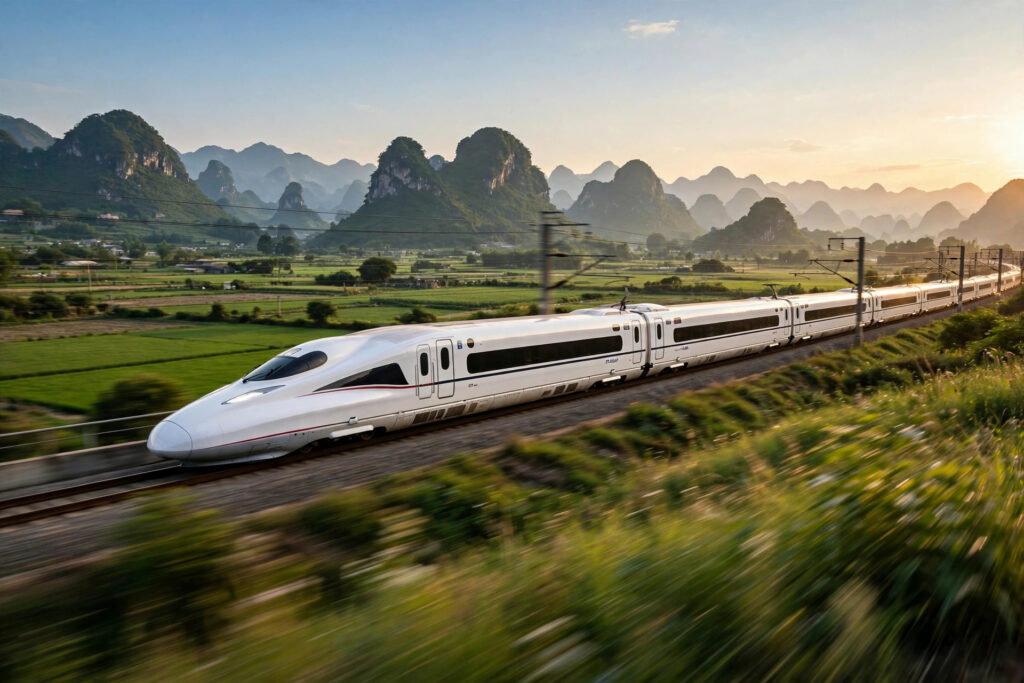
China’s high-speed rail is the single best way to move between cities on a trip — faster than flying once you count airport time, cheaper than a domestic flight, and an experience in itself. This guide covers everything a first-time visitor needs: train types, seat classes, how to book with a foreign passport, what to expect at the station, and current fares for the routes you will actually ride.
The short answer
Book your tickets on the 12306 app (free, official, English available) or Trip.com (easier, small service fee) up to 15 days before travel. Ride G trains for the fastest services, sit in second class unless you want more legroom, and arrive at the station 45–60 minutes early with the same passport you booked with.
Train types: G, D, C and the letterless classics
Every Chinese train number starts with a letter that tells you what kind of service it is:
- G (gaotie) — the fastest, running 300–350 km/h on dedicated high-speed lines. Beijing–Shanghai in about 4.5 hours.
- D (dongche) — fast electric trains, typically 200–250 km/h, including most overnight sleeper services.
- C (chengji) — short intercity high-speed runs between neighbouring cities, e.g. Beijing–Tianjin.
- Z / T / K (no “high speed”) — classic overnight trains with soft and hard sleepers. Slower, but useful for very long routes and they save a hotel night.
For almost every trip a visitor plans, G is the answer.
Seat classes: what you are actually buying
Second class (二等座) is comfortable, spacious and quiet — roughly airline premium-economy space, with power sockets under the seats. It is where most travellers, Chinese and foreign, sit. First class (一等座) buys noticeably wider seats and fewer neighbours per row for about 1.5× the price. Business class (商务座) is lie-flat luxury at roughly 3× the price, with meals and priority boarding.
On overnight trains you will see soft sleeper (软卧) — four bunks in a closed compartment — and hard sleeper (硬卧) — six bunks in an open carriage, still perfectly fine. D-series overnight trains also sell second-class sleepers.
Our advice: second class for day trains under 5 hours; first class for long day runs like Beijing–Guangzhou; a soft sleeper for overnight routes.
How to book: 12306 vs Trip.com
12306 — the official channel, free
Register on the English 12306 site or app with your passport details — no Chinese phone number is needed for the English version. Identity verification normally clears in minutes, but if manual review is triggered (common with foreign names) it can take three to five working days, occasionally up to two weeks. Register well before you need tickets — you cannot buy until verification clears.
Once set up, 12306 charges no booking fee, and it is the only place with the official waitlist (候补) system: if your train is sold out, you can join a free standby queue that automatically books you when someone cancels.
Trip.com — the easy channel, small fee
Trip.com books through an official channel for a small service fee per ticket. The interface is fully in English, accepts foreign cards reliably, and lets you place an early request before the 15-day window opens — it then submits your order the moment 12306 releases the tickets. This is genuinely useful for popular routes around holidays.
Both work. If you set up 12306 early, use it. If you are short on time or patience, Trip.com is the pragmatic choice.
How far in advance: the 15-day rule
Tickets go on sale 15 days before departure on every channel, including the travel day in the count — so a ticket for the 20th appears on the 6th. Each station releases its tickets at its own time of day (many around 14:00 Beijing time), so check your departure station’s release time in the app and be ready.
A few nuances worth knowing: some short C intercity trains open a little later, around 10 days; certain overnight sleepers may open around 20 days. The 12306 app shows the exact on-sale time for each train.
At the station: security, gates and timing
Chinese stations work like airports. You go through security screening and ID check first, wait in the departure hall, then board when the gate opens — usually 15–20 minutes before departure, closing a few minutes before the train leaves.
- Bring the exact passport you booked with. Your reservation is linked to the passport number; there is no printed ticket. Use the staffed manual lane at the gate, as the automatic readers are built for Chinese ID cards.
- Arrive 45–60 minutes early for your first trip. Big stations like Beijing South and Shanghai Hongqiao are enormous; holidays need more margin.
- Check the station, not just the city. Beijing has several major stations (Beijing South for high-speed), and so does Shanghai (Hongqiao vs Shanghai Railway Station). The wrong station means an expensive cross-city taxi.
- Food and water are fine to bring; there is no airport-style liquid limit. Note that all knives are banned from trains, including small penknives — security will confiscate them.
Luggage rules
Each adult passenger may carry up to 20 kg for free (children 10 kg). On high-speed (EMU) trains, each item’s length + width + height must not exceed 130 cm — roughly a standard airline suitcase. There is no checked baggage in the airline sense: you carry everything into the carriage and store it in overhead racks or the luggage areas at the carriage ends. In practice bags are rarely weighed, but a packed-full suitcase can be awkward to lift into the racks, so one manageable suitcase per traveller is the smart move. For oversized items, major stations offer a separate rail consignment service, or courier the bag hotel-to-hotel with SF Express.
Popular routes: time and fares
Second-class fares on the routes visitors ride most (fares change, so treat these as current ballparks — check before booking):
| Route | Time | Second-class fare |
|---|---|---|
| Beijing – Shanghai | ~4.5–6 h | ~¥553 |
| Beijing – Xi’an | ~4.5–5.5 h | ~¥515 |
| Shanghai – Hangzhou | 45–60 min | ~¥73 |
| Shanghai – Nanjing | ~75 min | ~¥140 |
| Shanghai – Suzhou | ~25 min | ~¥40 |
| Beijing – Guangzhou | ~8 h | ~¥862 |
| Xi’an – Chengdu | ~3.5 h | ~¥260 |
A note on fares: Beijing–Shanghai second class ranges roughly ¥553–697 depending on the specific service, and business class on that route runs about ¥1,988. Trains run every few minutes on the trunk routes, so you are choosing departure times, not hunting for the only train of the day.
These routes pair naturally with the places on this site: Beijing puts you within reach of the Great Wall, and Xi’an is the gateway to the Terracotta Warriors. For the overall shape of a first trip, see our First Time in China guide.
Holiday booking: when 15 days is not enough warning
On ordinary weeks, booking a few days ahead is fine. The exceptions are Chinese New Year, the early-May holiday, and the October Golden Week — plus Friday and Sunday evenings on busy corridors — when popular trains sell out within minutes of release.
The playbook: know your departure station’s release time, be on the app the moment the window opens on day one, and if you miss it, use the official 12306 waitlist rather than refreshing for days. Because many travellers book early and change later, waitlists on ordinary days succeed surprisingly often.
Overnight sleepers: the hotel that moves
On very long routes, consider a sleeper instead of a day train plus a hotel. The classic options are D-series overnight trains with proper berths, and Z/T trains with soft sleepers. Board around 20:00, sleep through the countryside, wake up at your destination. Beijing–Shanghai overnight D trains take about 12 hours and cost roughly ¥522–680 for a sleeper — worth comparing against a day-train ticket plus a hotel night.
Quick checklist
- [ ] 12306 account registered with passport (or Trip.com ready), verification cleared
- [ ] Know your departure station’s ticket release time; mark the 15-day window
- [ ] Same passport as booking, in hand at the station
- [ ] Arrive 45–60 minutes early; confirm the station, not just the city
- [ ] One manageable suitcase per traveller (20 kg / 130 cm limit on high-speed trains)
- [ ] Payment sorted — see our guide to paying in China, and check visa rules before you lock in dates
Concierge note: if juggling 15-day windows and station release times sounds like a chore, tell us your dates and cities — we can map out the rail legs of your trip and handle the booking strategy for you.