
Last updated: November 25, 2026
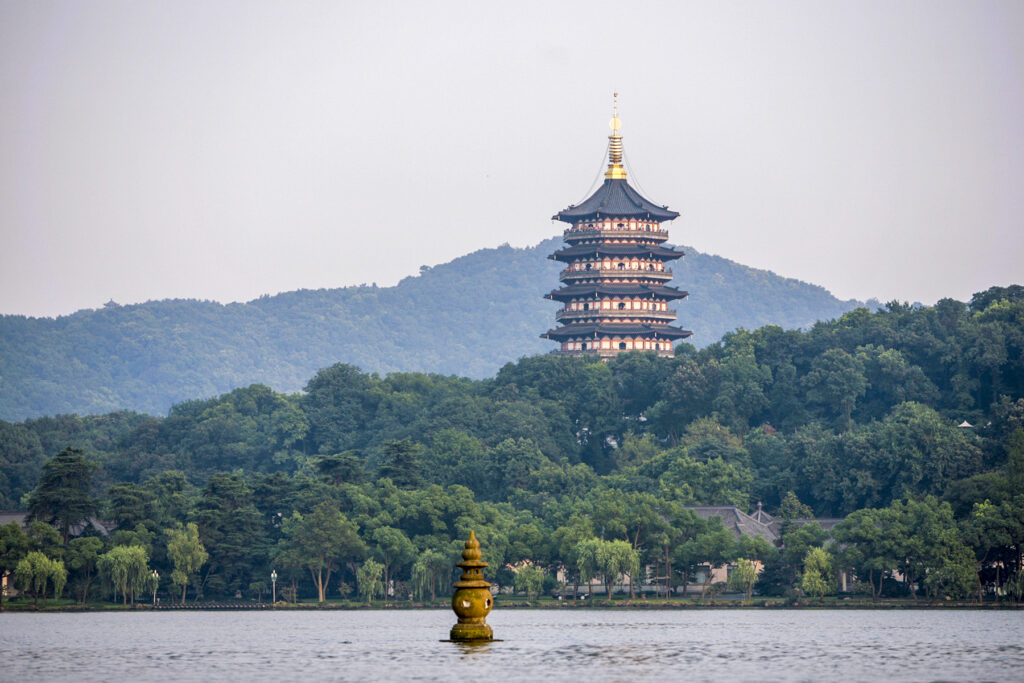
West Lake (西湖, Xī Hú) is the lake Chinese poets have written about for a thousand years, and the first sight most visitors to Hangzhou come to see. It is about 6.4 square kilometres of freshwater on the western edge of central Hangzhou, ringed by roughly 15 kilometres of willow-lined shore, green hills and pagodas — a UNESCO World Heritage cultural landscape since 2011. It is also one of the rare great sights in China that costs nothing to walk.
Is West Lake worth a day?
Yes — if you give it a slow pace. Walk the shoreline at midday in a holiday crowd and you will see a pretty lake and a lot of people. Arrive at 7 am, when mist sits on still water, or at dusk, when the light turns gold on Leifeng Pagoda, and you will understand why a thousand years of poets never left it alone. The lake has no single gate, so pick one stretch and walk it properly rather than circling all 15 kilometres of shore.
The Ten Scenes — and which ones to chase
The Ten Scenes are ten views named during the Southern Song dynasty, when Hangzhou was China’s capital, each pairing a place with a season or time of day. You do not need all ten:
- Spring Dawn on the Su Causeway (苏堤春晓) — the most famous: the causeway on a spring morning, peach blossom and fresh willow leaves together.
- Leifeng Pagoda in Evening Glow (雷峰夕照) — the south-shore pagoda at sunset. End the day here, ideally from the top.
- Three Pools Mirroring the Moon (三潭印月) — the island in the middle of the lake, reached only by boat. Its three stone pagodas are on the back of the ¥1 banknote.
- Autumn Moon over the Calm Lake (平湖秋月) — a clear autumn evening on the north shore, near the Bai Causeway.
- Remnant Snow on the Broken Bridge (断桥残雪) — the Broken Bridge after snowfall. It needs real snow — a bonus, not a plan.
A one-day route that works
Start early: metro to Longxiangqiao, walk to the Hubin shore on the east side, then cross to the north shore and the Broken Bridge. Walk the Bai Causeway west to Gushan Island — named after the Tang governor Bai Juyi — then join the Su Causeway and walk south across the lake. The Su Causeway is the one to take your time on: 2.8 kilometres of willows, peach trees and six arched stone bridges, built from lake silt dredged under the Song poet-governor Su Dongpo (1037–1101). At the south end is Flower Harbour and the foot of Leifeng Pagoda. From there, take a boat to the island of Three Pools Mirroring the Moon (about 1.5–2 hours), then climb the pagoda for sunset.
Boats: which one, and what they cost
There are two kinds of boat. The sightseeing boat to Three Pools Mirroring the Moon is the practical one: a round trip including the island landing, roughly ¥55–70, sailing about 07:30–17:00, tickets at the pier. The hand-oared boat (手划船) is the romantic one: a small wooden boat rowed by hand, ¥150–180 per hour per boat, seating two to six — the best way to see the lake slowly, and the only boat that drifts close to the lotus beds. New for 2026 is a Song-themed night sailing to the same island, 诗酒趁年华: ¥188, sailings 18:40–20:40 from the eastern-shore piers, sold at the pier on the day — check times before booking, as they can change with the season.
Tickets and prices in 2026
The lake, both causeways, the lakeside parks and most of the open scenery are free, day and night. A handful of enclosed sights charge:
- West Lake, Su Causeway, Bai Causeway, lakeside parks: free, open 24 hours.
- Leifeng Pagoda (雷峰塔): ¥40 for adults (¥20 for ages 6–18). Open 08:00–20:00 from May to October, 08:00–17:30 from November to mid-March. Rebuilt in 2002 over the ruins of the Song original, which collapsed in 1924.
- Boat to Three Pools Mirroring the Moon: about ¥55–70, including the island landing.
- Hand-oared boat: ¥150–180 per hour, per boat.
- Temple of Yue Fei (岳王庙): ¥25, open 07:30–17:30 — the shrine to the Song dynasty general, on the north shore.
- Six Harmonies Pagoda (六和塔): park ticket ¥20, climbing an extra ¥10 (combined ¥30), open 07:00–17:30. It stands above the Qiantang River, south of the lake.
There is no combined ticket: you pay per attraction, only for the ones you enter.
The Lingyin Temple rule — read this before you go
Lingyin Temple, the great Buddhist temple just west of the lake, is the one part of a West Lake day you cannot improvise. Since 1 December 2025, the whole Feilai Feng scenic area around it — Lingyin Temple, Yongfu Temple and Taoguang Temple — has been free, but entry is by free timed reservation, booked 1–7 days ahead, with no same-day option. Bookings are real-name, made with your passport in the Alipay or WeChat mini-program, released daily at 08:00, and capped (about 35,000 on weekdays, 50,000 at weekends, 65,000 on holidays). Hours are 07:30–17:30, last entry 17:00.
Many English-language guides still list Lingyin at ¥45 or ¥75 — the old ticket was abolished on 1 December 2025, and the booking requirement replaced it. Turn up without a reservation and you will not get in, so book the moment your dates are fixed.
Getting there
Hangzhou is about an hour by high-speed train from Shanghai, which makes West Lake an easy day trip — see our 3 days in Shanghai for first-timers if you are based there. From Hangzhou East station, take metro Line 1 to Longxiangqiao (龙翔桥), Exit C — about 30 minutes, then a five-minute walk to the Hubin shore. Ding’an Road, one stop further south, is the better stop for the southern shore and the foot of the Su Causeway. From Suzhou the train takes under two hours — our Suzhou day trip guide pairs well with a Hangzhou stop — and Huangshan is about two hours away by high-speed train.
Getting around the lake
Walk the causeways and take a boat across the middle — about three to four hours for both the close-up views and the layout of the lake. Both causeways are flat, shaded and car-free. One rule to know: bicycles are banned on both causeways outright, all day, since 2018 — the rule bars non-motorised vehicles from entering, so pushing a bike across is not a loophole either. Shared bikes suit the flat shore roads, but leave them before the causeways. A sightseeing bus loops the lake if your legs give out, and DiDi works well for the Longjing tea hills (see our guide to using DiDi in China).
When to go
Spring (March–April) and autumn (late September–November) are best: spring brings peach blossom and the Longjing tea harvest; autumn brings osmanthus scent and clear skies. Summer is hot and crowded; mid-to-late June is the plum-rain season, when the lake wraps itself in mist and rain. Winter is quiet, and beautiful if snow falls on the Broken Bridge. Within the day, go early morning (6–8 am) or at dusk (after 5 pm). Avoid the long public holidays — Chinese New Year, Labour Day and the National Day week of 1–7 October — when the causeways get so crowded you can barely move. A weekday beats a weekend.
Where to stay and what to eat
Stay near the lake if you can. Hubin, on the east shore, puts you a five-minute walk from the water, with the most restaurants and the easiest metro access — but also the busiest and dearest part of town. The quieter choice is the western or southern side, around the tea hills or the Su Causeway. Either way, book a hotel that accepts foreign guests — our guide to booking hotels in China as a foreigner explains the front-desk refusal to avoid. One night is enough for the highlights; two lets you add Lingyin Temple and the tea villages without rushing.
Hangzhou food is gentler than Sichuan’s fiery cooking — delicate, a little sweet, built around the lake and the tea hills. The classics are Dongpo pork (东坡肉), named after Su Dongpo himself; West Lake vinegar fish (西湖醋鱼); Longjing shrimp (龙井虾仁), cooked with the local green tea; and beggar’s chicken (叫花鸡), baked in clay. Hefang Street and the restaurants around Hubin are the easiest places to find them; for more on ordering and costs, see our China food guide for first-timers.
Practical tips
- Money: the lake is free, but pagoda, boats and temples are cashless. Set up mobile payment before you arrive — see our guide to paying in China as a foreigner.
- Tickets: Leifeng Pagoda and the boats can be bought on the day, at the site or in the scenic area’s WeChat mini-program. Lingyin Temple is the exception: book 1–7 days ahead. For the general rules, see how to book attraction tickets in China.
- Crowds: the east shore and Broken Bridge are busiest. The western shore, the far end of the Su Causeway and the tea hills are where the lake gets quiet.
- Prices change: figures were checked for late 2026, but hours and fares can shift — check before booking, especially the evening boat and Lingyin rules.
West Lake is the gentlest possible introduction to China: no ticket gate, no single correct route, and a landscape painted and written about for a thousand years without losing its pull. Walk it early, take the boat across, climb the pagoda at sunset — and book Lingyin Temple in advance. If you would like Hangzhou fitted into a wider trip, with the lake, the tea hills and the onward journey planned around your dates, our travel concierge can shape it into a day-by-day plan.