
Last updated: November 27, 2026
Chongqing is the city that makes first-time visitors stop and stare. A municipality of more than 30 million people, stacked on steep hills where the Yangtze and Jialing rivers meet, it behaves like nowhere else in China: metro trains run through apartment blocks, and the whole centre glows after dark. Locals call it the “8D city”, and after a day of climbing its stairs you will understand why.
It is also one of the easiest big Chinese cities to enjoy without a plan: the headline sights are free or nearly free, the metro is cheap, and the food — fiery hotpot and bowls of xiaomian noodles — is the main event. This guide gives you a realistic three-day plan and the 2026 prices we could verify.
How many days do you need in Chongqing?
Two days cover the city itself: one for the Yuzhong peninsula and one for Liziba, Ciqikou and the viewpoints, with both evenings at the river. A third day buys one trip out of town — Dazu or Wulong, both UNESCO World Heritage sites; a fourth buys the other one. Less than two days and you will spend the whole visit in queues; more than four and you are better off moving on to Chengdu, an hour away by high-speed train.
Day 1: The peninsula, the river and the neon
Morning: Jiefangbei and Bayi snack street
Start at Jiefangbei, the pedestrian district built around the People’s Liberation Monument — a 27-metre clock tower completed in 1947. Entry is free and the square is always open. From there, walk to nearby Bayi Haochi Street for breakfast: xiaomian (small noodles in chilli oil), dumplings and grilled snacks, usually ¥10–30 a portion.
Afternoon: The Yangtze cableway
The Yangtze River Cableway opened in 1987 as ordinary public transport and now works mostly as a scenic ride: about 1,166 metres across the river in roughly four minutes. The fare is ¥30 one way or ¥50 return (2026 prices), and the queue is shortest in the early afternoon. Ride south, walk the Longmenhao old street on the far bank, then ride back.
Evening: Hotpot, then Hongyadong at night
Book a hotpot dinner for your first night and ask for yuanyang guo (鸳鸯锅, a split pot: fiery mala broth on one side, clear broth on the other). Expect about ¥80–150 per person at a mid-range restaurant; the standard dip is sesame oil with garlic.
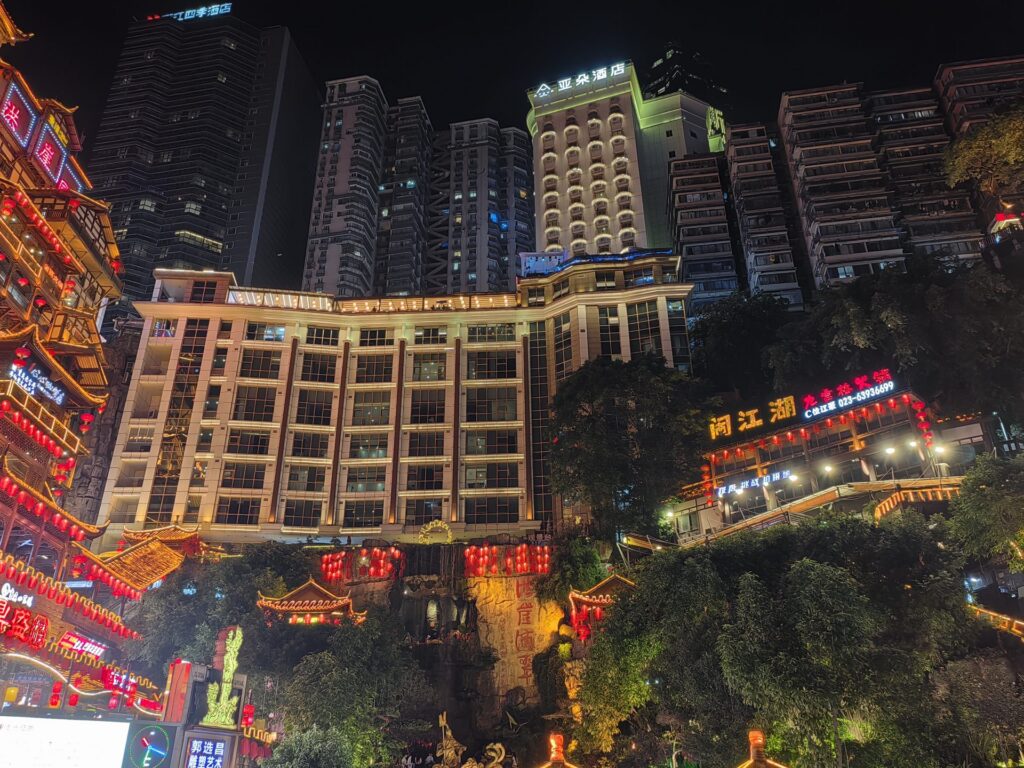
Then walk to Hongyadong (洪崖洞), the eleven-storey stilt-house complex lit up above the Jialing River. Entry is free, but at busy times you need a free timed slot booked through the official Hongyadong mini-program — do it the evening before, and arrive before 7 pm for the best photographs. The lights run from 18:30 to 23:00; for the postcard view, cross Qiansimen Jialing River Bridge or take a two-rivers night cruise (typically ¥140–200).
Day 2: The monorail, the old town and the viewpoints
Morning: Liziba, the train through a building
Take Metro Line 2 to Liziba, where the monorail passes through a residential block — the scene that made Chongqing famous on social media. The viewing platform is free and sits outside the ticket gates, so you do not need to ride, and the morning light is best.
Late morning: Ciqikou Ancient Town
Ride Line 1 to Ciqikou, Exit 1. This old porcelain port is free to enter and at its best before the tour groups arrive, so go before 10 am. Allow about two hours for the lanes, tea houses and riverside snacks — mahua (fried dough twists) is the local speciality.
Afternoon: Museums and a hilltop view
The Three Gorges Museum is free, needs no booking since October 2025 — just bring your passport — and is closed on Mondays. If the weather is clear, finish at Eling Park or the Nanshan viewpoint across the river, where the peninsula lights up at dusk.
Day 3: One day trip — Dazu or Wulong
Pick one: both are UNESCO World Heritage sites and both deserve a full day, so combining them is the classic Chongqing mistake.
Dazu Rock Carvings (大足石刻) is the art choice: Buddhist, Taoist and Confucian reliefs carved into rock faces over a thousand years ago, including a giant reclining Buddha and a thousand-armed Guanyin. High-speed trains from Shapingba reach Dazu South in about 20 minutes, though only a handful stop there each day. The Baodingshan ticket is ¥115 (¥100 from December to February), plus about ¥22 return for the internal shuttle bus.
Wulong Karst (武隆喀斯特) is the nature choice: giant limestone sinkholes and natural stone bridges, a filming location for Transformers: Age of Extinction. The Three Natural Bridges ticket is ¥125 in the low season and ¥155 in the high season (2026 prices); the trip takes 10–12 hours door to door.
Chongqing’s essential sights and 2026 prices
| Place | 2026 price | Time needed | Notes |
|---|---|---|---|
| Hongyadong | Free (timed slot at busy times) | 1–2 hours | Best at night |
| Yangtze River Cableway | ¥30 one way, ¥50 return | 30–60 min with the queue | Quietest in the early afternoon |
| Liziba monorail viewpoint | Free | 30 min | Outside the ticket gates; morning light is best |
| Ciqikou Ancient Town | Free | 2 hours | Go before 10 am |
| Jiefangbei & Bayi Road | Free | 1–2 hours | Best in the morning, for breakfast |
| Three Gorges Museum | Free | 1–2 hours | Closed Mondays |
| Dazu Rock Carvings | ¥115 (¥100 Dec–Feb) | Full day | Train to Dazu South, then a bus |
| Wulong Karst | ¥125 low season, ¥155 high season | 10–12 hours | Book the shuttle in advance |
Prices and hours change — check before you go, especially around public holidays, when queues and prices both rise.
Eating in Chongqing: hotpot first, noodles second
Chongqing hotpot is not the same as Chengdu hotpot, and locals will tell you so at length. The broth here is heavier on beef tallow and Sichuan peppercorn, the heat builds rather than hits: order a split pot on your first night, cook thinly sliced meats and leafy vegetables in small batches, and dip everything in sesame oil with garlic. If the menu is only in Chinese, point at what other tables are eating.
For the rest of the day, live on xiaomian: small bowls of wheat noodles in chilli oil with peanuts and spring onion, about ¥10–15 everywhere. Say wei la (微辣, mildly spicy) unless you are sure. Our China food guide for first-timers covers ordering and dietary words in more detail.
Getting there and getting around
Most visitors arrive at Chongqing Jiangbei International Airport (CKG), about 40 minutes from the centre by metro, or by high-speed train from Chengdu (about an hour). Chongqing has two main railway stations, North and West — check which one your ticket uses.
Inside the city, the metro is the answer to almost everything: fares run ¥2–10 a ride, and Lines 1 and 2 cover the peninsula, Liziba and Ciqikou. Pay with Alipay or WeChat Pay, as described in our China payment guide. For booking trains, see our China high-speed rail guide.
Where to stay
Stay in Yuzhong district, on the peninsula, near a metro station. Jiefangbei puts you within walking distance of Hongyadong, the cableway and the snack streets, and Lines 1 and 2 run through it. Budget hotels run about ¥120–200 a night and mid-range about ¥250–450. If you are booking for the first time in China, read our guide to booking hotels as a foreigner before you pay: not every hotel is licensed to accept foreign guests, and that is a problem you want to catch at booking, not at the front desk.
Best time to visit Chongqing
March to May and September to November are the best months: warm days, clear river views and bearable crowds. Summer (June to August) is the hard season — Chongqing is one of China’s “furnace” cities, and temperatures regularly pass 35°C with heavy humidity. Winter is mild but famously foggy. Avoid the first week of October and Chinese New Year unless you enjoy queues.
Practical notes for first-timers
Visa: citizens of 48 countries can currently enter China visa-free for up to 30 days, under a policy that runs to 31 December 2026 — check before booking, as no extension for 2027 had been announced at the time of writing.
Stairs: this is a vertical city, and a “ground floor” can be the 22nd floor. Wear comfortable shoes, allow extra time for every walk and do not plan more than three big sights in a day.
Booking: little in Chongqing sells out outside public holidays. What needs a booking asks for it in your name, so carry your passport for the free museums and the Hongyadong timed slot — common traps are covered in our first-timer mistakes guide.
Language: English is limited outside hotels and the main sights. Download a translation app and offline maps, and save your hotel’s name in Chinese characters — showing it to a taxi driver works every time.
Is Chongqing worth it?
Yes — and not just as a stopover. Chengdu gets the pandas and Xi’an gets the warriors, but Chongqing is the Chinese city that feels least like anywhere else: a mountain city that built itself upwards, eats fire for dinner and glows after dark. Three days is enough to see it properly, and our two-week China itinerary shows how it fits into a first visit with Beijing, Xi’an and Chengdu.
If you would like this plan shaped around your own dates, pace and budget — including the Dazu or Wulong day trip, the right base in Yuzhong and the train connections onwards — our travel concierge can build it for you. Want this itinerary tailored to your dates? Our Route Design ($180) turns it into a day-by-day plan.