
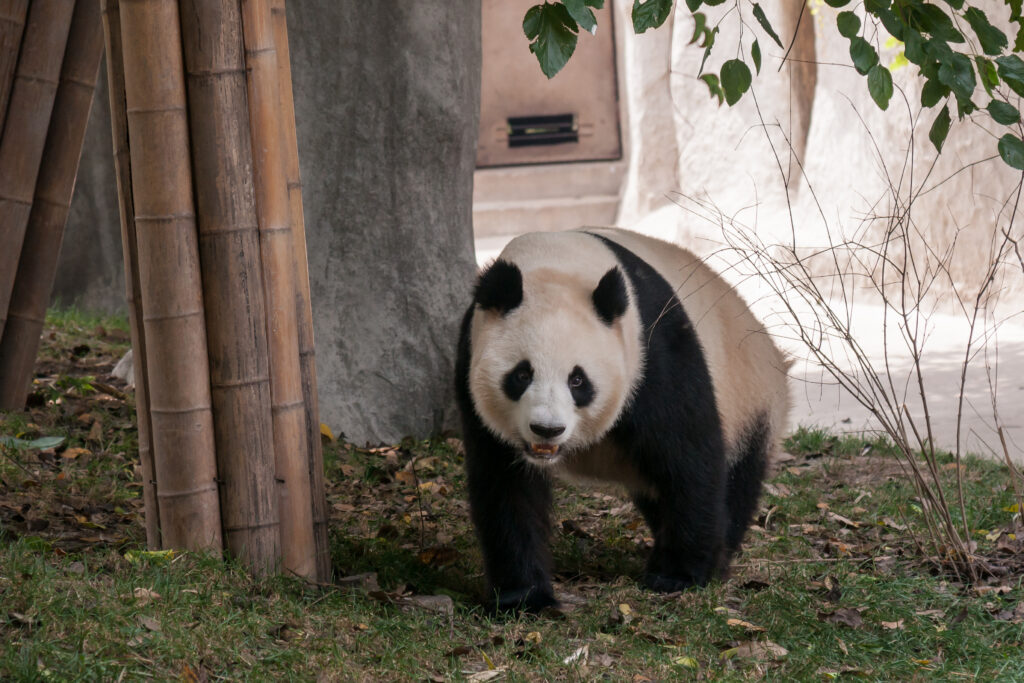
Chengdu is the easiest city in China to love on arrival. Within an hour of landing you can be watching a giant panda strip bamboo with total concentration, and by evening you will be sitting in a teahouse with a covered bowl of tea, watching locals play cards as if they had all the time in the world. That unhurried rhythm is the point of Chengdu — China’s capital of slowing down, which also happens to serve some of the best food on earth.
Three days is the sweet spot: one for pandas and old streets, one for teahouse-and-temple pace, and a third for a day trip. Two days works if time is tight; four lets you add a second day trip.
Day 1 — Pandas at dawn, old streets at dusk
The Panda Base: go early or do not go
The Chengdu Research Base of Giant Panda Breeding sits about 10 km north of the city centre and is home to more than 200 giant pandas, plus red pandas. It is a large, leafy campus, so allow 3–4 hours and wear comfortable shoes.
- Tickets: ¥55 per adult, ¥27 for students with ID. Children under 6 or under 1.3 m and visitors aged 60+ enter free with ID. A sightseeing bus inside costs ¥30 for up to five rides.
- Hours: March–October 07:30–18:00; November–February 08:00–17:30. Entry runs in morning and afternoon sessions, and there is no ticket window at the gate — book ahead with a real-name reservation using your passport. Passport holders most easily book through Trip.com.
- Getting there: Metro Line 3 to Panda Avenue Station, then shuttle bus 408 to the South Gate, or a taxi from the station (about 10 minutes). Direct shuttles also run from Chunxi Road.
- The one rule that matters: pandas are most active at feeding time, roughly 08:00–10:00. By afternoon most are asleep. Arrive at opening, head for the adult enclosures and the Sunlight Nursery first, and save the museum and red pandas for later. No flash photography, and no selfie sticks or tripods past security.
If the base’s star, Hua Hua, is on your list, expect a queue at her enclosure. The rest of the base is much calmer, so do not spend your whole morning in one line.
Afternoon: Kuanzhai Alleys, then Jinli after dark
Back in the city, head to Kuanzhai Alleys (宽窄巷子), three Qing-dynasty lanes of grey-tiled courtyards now filled with teahouses, craft shops, and snack stalls. Entry is free; Metro Line 4, Kuanzhai Alleys Station, drops you at the door. The main lanes are commercial and crowded — the charm is in the side courtyards, where you can sit with tea and watch the street go by. Allow about an hour.
In the late afternoon, cross town to Wuhou Shrine (武侯祠), the temple and museum to Zhuge Liang and Liu Bei of the Three Kingdoms era, with bamboo gardens and quiet halls. Entry is ¥50; hours are roughly 08:00–20:00 — check before booking, as seasonal hours shift. It is worth it even if you know nothing about the Three Kingdoms: the courtyards and old trees do the work.
Then walk next door into Jinli Ancient Street (锦里古街) as the lanterns come on, around 18:30. Jinli is free to enter and at its best after dark, when red lanterns light the lanes and snack stalls fill up. Eat your way along it — skewers, dumplings, sugar paintings — but treat it as a snack crawl rather than your main dinner.
Day 2 — Chengdu at local speed
Day 2 is for the Chengdu locals actually live in, and it starts in People’s Park (人民公园). Arrive mid-morning, find a teahouse by the lake, and order a covered bowl of tea (gaiwan cha) — the waiter will keep topping up your hot water all afternoon for a few yuan. This is Chengdu’s famous slowness on full display: ear cleaning (a gentle, oddly relaxing ritual performed on teahouse chairs), matchmaking corners, and groups dancing, singing opera, and playing mahjong in the open air. Joining in is welcomed; watching with tea in hand is equally fine.
From the park it is a short walk to Chunxi Road and Taikoo Li, Chengdu’s modern shopping heart, where the giant panda sculpture climbing the IFS building has become the city’s most photographed selfie spot. It is glossy, crowded, and fun for an hour — a useful contrast to the old lanes.
Spend the afternoon at Wenshu Monastery (文殊院), a thousand-year-old Zen temple that is free to enter and far quieter than the shopping streets. It is a genuine place of worship, not a set — keep voices down and cameras respectful. Its teahouse and vegetarian cakes are a local institution.
Eating in Chengdu: a survival note
Chengdu food deserves its own plan, and we wrote one: our Chengdu food guide covers hotpot etiquette, the dishes to order first, and how to handle the heat if you are not a chilli eater. The short version: hotpot is the evening ritual — pick a split broth (mala on one side, mild on the other) if your group is mixed, and budget around ¥80–150 per person. For lunch, dan dan noodles, mapo tofu, and Zhong dumplings in chilli oil are cheap, fast, and everywhere. If a menu has no English, point, smile, and use a translation app — Chengdu restaurants are used to it.
One practical point: Sichuan spice builds. Your first meal should not be your hottest. Start medium, and save the full mala assault for day 2.
Day 3 — A day trip: Leshan or Dujiangyan
Chengdu is one of China’s best day-trip bases. Pick one of these two; do not try both in a day.
Leshan Giant Buddha (best for a wow moment). The 71-metre cliff-carved Buddha is about an hour by high-speed train from Chengdu East to Leshan Station (second class around ¥54), then a bus or taxi to the scenic area. Entry is around ¥80; a river sightseeing boat, which gives you the full frontal view without the long stair climb, is around ¥70 extra. The walking route down to the Buddha’s feet is steep and can queue for a long time in peak season — the boat is the smarter choice if you are short on time or knees. Allow a full day, and eat lunch in Leshan’s old town before heading back.
Dujiangyan and Qingcheng Mountain (best for culture and air). Dujiangyan’s 2,300-year-old irrigation system still waters the Chengdu Plain today — entry around ¥80. Nearby Qingcheng Mountain, a green Taoist mountain of temples and forest paths, is around ¥80 for the front mountain, with cable cars extra. The two combine into a full, gentler day, reachable by metro to Xipu and intercity rail onward. Start early and check current arrangements before you go, as mountain transport changes seasonally.
Either trip is simple to run yourself — our China High-Speed Rail Guide covers booking on Trip.com or 12306, and how to pay in China covers the Alipay and WeChat Pay setup you will need.
Getting there, staying, and when to go
Arriving: Chengdu has two airports — Tianfu International (TFU), the main international gateway, and Shuangliu (CTU). Both connect to the metro network; Tianfu is further out, so allow more time. High-speed trains arrive at Chengdu East, Chengdu South, and Chengdu West stations, all metro-connected. If Chengdu is one stop on a longer route, our two-week China itinerary slots it between the cities and the mountains, and it pairs naturally with Jiuzhaigou — the high-speed line from Chengdu East reaches Huanglong Jiuzhai station in about two hours.
Where to stay: First-timers do best around Chunxi Road / Taikoo Li (dining, shopping, metro connections) or the Kuanzhai Alleys area (atmosphere, easy walk to People’s Park). Mid-range hotels run roughly ¥300–600 per night. Staying near a metro station matters more than the district — Chengdu’s metro is cheap, frequent, and English-signed.
When to go: Spring (March–May) and autumn (September–November) are the most comfortable — mild, less humid, pandas active. Summer is hot, humid, and crowded, and the pandas sleep more; winter is quieter and cooler, and the pandas are often livelier in the cold. Chengdu is famously overcast, so plan around tea, food, and indoor-outdoor balance, not sunshine.
Budget: Excluding accommodation, a comfortable day — panda base (¥55), transport, a temple or two, snacks, and hotpot — runs roughly ¥250–400 per person. See our 2026 cost guide.
Practical notes
- Visa: Around 50 nationalities get 30-day visa-free entry as of 2026; see our China visa-free guide.
- Connectivity: Get your eSIM working before you arrive — see our eSIM guide. Google Maps does not work in mainland China; Amap (高德地图) covers Chengdu’s metro and day-trip routes.
- Cash: Not needed. Alipay and WeChat Pay work at the panda base, on the metro, and at street stalls.
- Language: English signage is good on the metro and at major sights, thinner in restaurants and markets. A translation app and a screenshot of your hotel name in Chinese characters solve most problems.
- Best time to visit China overall: our best time to visit China guide breaks it down month by month and region by region.
Chengdu rewards the traveller who stops rushing. Go to the pandas early, drink tea slowly, and eat bravely but in stages.
If you would rather not juggle panda-base reservations, train tickets, and restaurant choices across three days yourself, our travel concierge builds the route around your dates, books the tricky tickets, and stays on WhatsApp while you travel.