
Last updated: October 23, 2026
Beijing is enormous. The city sprawls across six ring roads, and the sights you came for sit in very different corners: the Forbidden City in the middle, the Summer Palace in the north-west, the Temple of Heaven in the south, the Great Wall an hour or two out of town. Where you sleep decides how much of your trip is spent underground on the subway. This guide compares the neighborhoods that make sense for visitors, what hotels typically cost, and how to book without surprises.
Price figures below are typical ranges taken from several 2026 hotel guides and booking-site data, converted at roughly CNY 7.1 per US dollar. Rates swing a lot with the season (Golden Week in early October and the Spring Festival period are the most expensive; January and February are cheapest), so treat them as planning numbers and check live prices before you book.
Beijing neighborhoods at a glance
| Area | Best for | Typical price per night | Subway |
|---|---|---|---|
| Wangfujing / Dongcheng | First-timers, sightseeing, families | CNY 300-1,500 (US$42-210) | Lines 1, 5, 8 |
| Gulou / Nanluoguxiang / Houhai | Hutongs, boutique courtyard hotels, photography | CNY 200-1,800 (US$28-250) | Lines 2, 6, 8 |
| Qianmen / Dashilan | Budget travelers who want to be central | CNY 150-700 (US$21-100) | Lines 2, 7, 8 |
| Sanlitun / Chaoyang | Nightlife, restaurants, expats | CNY 300-2,500 (US$42-350) | Lines 6, 10 |
| Guomao CBD | International-brand hotels, business travel | CNY 790-1,850 (US$110-260) | Lines 1, 10 |
| Haidian | Summer Palace, universities, Olympic Park | CNY 100-800 (US$14-110) | Lines 4, 10, 13 |
Wangfujing and Dongcheng: the safe choice for a first visit
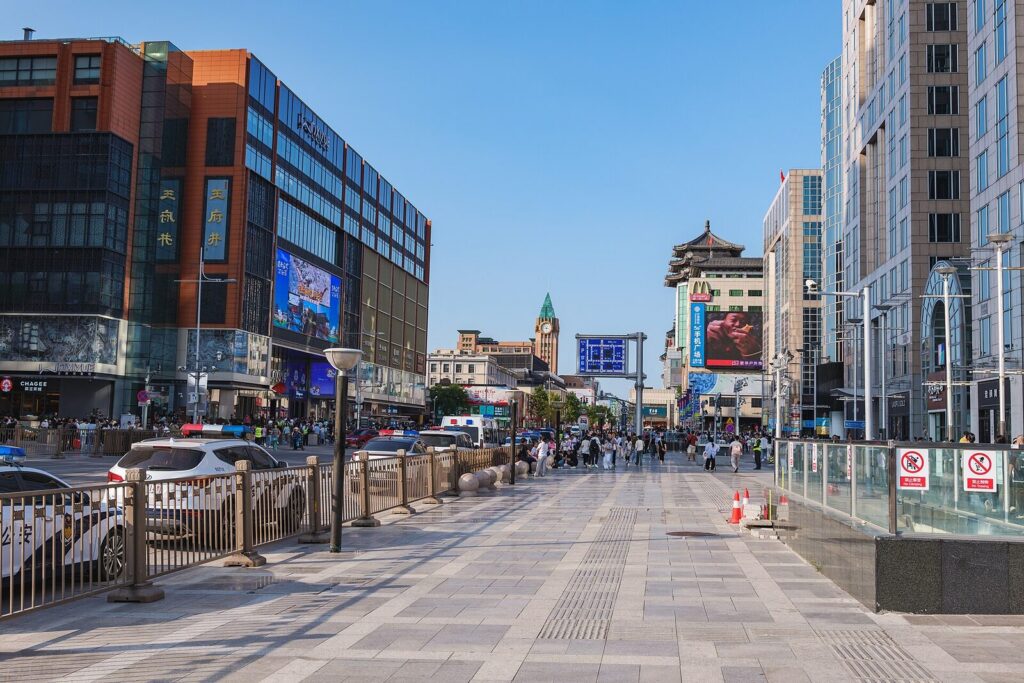
Almost every guide agrees on this one. Dongcheng is the historic and tourist core, and Wangfujing, its best-known shopping street, is the most convenient base. The Forbidden City and Tiananmen Square are roughly a 15 to 25 minute walk away, Jingshan Park is close by, and Wangfujing station on Line 1 connects you straight to Tiananmen East and the rest of the network.
Pros
- Walk to the biggest sights and save hours of transit.
- The widest range of hotels in the city, from budget chains to five-star properties.
- Dozens of restaurants, malls and late-night snack streets within a few minutes.
- English is more widely understood at hotel front desks here than anywhere else.
Cons
- Prices are higher than in less central districts, especially at weekends.
- Wangfujing street itself is touristy and crowded; the food stalls are more novelty than bargain.
- It feels less like “old Beijing” than the hutong districts.
Typical cost: mid-range 4-star hotels usually land around CNY 800-1,400 (US$110-195) a night; five-star hotels start higher. Budget chains such as Hanting, Home Inn and 7 Days cost far less but may be a few streets away from the pedestrian zone.
Gulou, Nanluoguxiang and Houhai: hutong atmosphere
North of the Forbidden City, the lanes around the Bell and Drum Towers, the Houhai lakes and Nanluoguxiang are where Beijing’s grey-brick alleys survive. Staying in a restored courtyard hotel is the closest thing in the city to a “boutique” experience, and many have a quiet garden inside walls that block the street noise.
Pros
- Character: courtyard houses, tea rooms, small bars, lakeside walks.
- Good subway links via Line 2 (Gulou Dajie, Andingmen) and Line 8.
- Many small hotels in the CNY 400-1,000 (US$55-140) range.
Cons
- Thin courtyard walls and weekend bar noise near Nanluoguxiang and Houhai.
- Some traditional properties have no elevator or limited central heating, which matters in winter.
- Taxis and ride-hailing cars struggle to enter narrow lanes, so you may walk the last few minutes with your luggage.
Qianmen and Dashilan: central on a budget
South of Tiananmen Square, Qianmen is a restored old commercial street with the Dashilan lanes beside it. It is walking distance from the square and close to the Temple of Heaven, yet hotel and hostel rates are noticeably lower than in Wangfujing. Expect hostels with private rooms, cheap chain hotels and a few hutong guesthouses. It is a strong pick if you want to spend your money on food and tickets instead of the room.
Watch out for: some very small guesthouses in the old lanes cannot accept foreign guests because they are not licensed for it. Always confirm that the property accepts international passports before you pay (more on this below).
Sanlitun and Chaoyang: nightlife and modern Beijing
Chaoyang is Beijing’s international district: embassies, rooftop bars, big malls and a huge variety of foreign restaurants. It suits travelers who have been to China before, or who care more about dining and nightlife than temples. Rooms range widely, from around CNY 300 (US$42) to over CNY 2,500 (US$350). The Forbidden City is a 25 to 35 minute subway ride away, so it is not ideal if you have only two or three days.
The Guomao CBD is the high-rise cousin: reliable international-brand hotels (typically CNY 790-1,850, or US$110-260), strong air-conditioning and gym facilities, and Line 1 and Line 10 connections. It is a practical base for families who want predictable modern rooms, but there is little local flavor.
Haidian: only if the Summer Palace is your priority
Haidian in the north-west holds the Summer Palace, Peking and Tsinghua universities, and the tech hub of Zhongguancun. Rooms are among the cheapest of any well-connected district (CNY 100-800, or US$14-110). Unless the Summer Palace or Olympic Park is your focus, you will spend a lot of time commuting to the city center. For a first trip, we would not choose it.
Which area for which traveler?
| If you are… | Stay in |
|---|---|
| First time in Beijing, 3-5 days | Wangfujing / Dongcheng |
| A returning visitor who wants charm | Gulou, Nanluoguxiang or Houhai |
| Watching your budget but want to walk to Tiananmen | Qianmen / Dashilan |
| Here for restaurants and nightlife | Sanlitun |
| Traveling with kids or on business | Guomao CBD or Wangfujing |
| Mostly visiting the Summer Palace | Haidian |
How much do Beijing hotels cost?
Beijing has thousands of hotels (one booking site lists over 9,000), so there is a room at almost every price. A rough ladder for 2026:
- Hostel dorm beds: CNY 80-120 (US$11-17) per bed.
- Budget hotels and private hostel rooms: under CNY 300 (about US$42). Chains like Hanting, Home Inn and 7 Days are clean and functional, with limited English.
- Mid-range: CNY 300-1,000 (US$42-140). Four-star chains, courtyard boutique hotels and Atour-style lifestyle brands.
- Upscale and luxury: CNY 1,000-3,200+ (US$140-450+). Five-star towers and heritage hotels near the Forbidden City.
Some travel sites quote average well-located mid-range rates of US$80-150 and US$250-500 or more for five-star addresses in Dongcheng and Chaoyang during peak periods. Average nightly rates for a specific hotel can differ by more than 50% between the cheapest and the busiest month.
Step by step: how to book a Beijing hotel as a foreigner
- Pick your area first, then the hotel. Map your top three sights per day. If two or more are around the Forbidden City, base yourself in Dongcheng.
- Use an international booking site or Trip.com. Trip.com’s English version and international sites such as Booking.com and Agoda list properties that accept foreign passports. Filter for free cancellation.
- Check that the hotel accepts foreign guests. Hotels need to be licensed to host foreigners. If the listing is in English on an international site, it usually is, but confirm by message for small guesthouses.
- Bring your passport. You must show it at check-in; the hotel registers you with the local police system. If you rent an apartment or stay with friends, see our guide to registering your accommodation online.
- Ask about a deposit. Many hotels take a CNY 200-500 refundable deposit at check-in, often by card or cash. Our guide to paying in China explains what works for visitors.
- Save the address in Chinese. Screenshot the hotel’s name and address in Chinese characters for taxi drivers. Add the hotel’s phone number too.
Practical tips
Getting from the airport
Beijing Capital (PEK) is about 30 km from the center and the Airport Express train runs to Dongzhimen and Sanyuanqiao, where you transfer to Lines 2 and 10. Daxing (PKX) in the south has its own express line to Caoqiao. Taxis and ride-hailing are simple once you have set up Didi. If you land late with heavy luggage, a hotel within a short ride of the subway line is worth a small premium.
Stay connected
Hotel Wi-Fi can be slow and Google services are blocked. Set up a travel eSIM before you fly; our China eSIM guide and VPN vs eSIM comparison explain the options. The essential apps list covers maps, translation and payments.
Plan the Great Wall day
Wherever you stay, the Great Wall is a day trip. Read which section to visit and use our Beijing 3-day itinerary to see how the neighborhoods above fit a real schedule. If you are also heading to Xi’an by high-speed train, see how to book China train tickets.
Season and noise
- Golden Week (early October) and Chinese New Year are the priciest; book weeks ahead.
- Winter (December to February) is cheapest but cold, and some courtyard hotels are drafty.
- Ask for a room away from the street if you stay near Houhai or Sanlitun on a weekend.
Common mistakes to avoid
- Booking a hotel near Beijing South or West railway station thinking it is central. It is not; those areas are transit hubs.
- Choosing a cheap room in Haidian or the far suburbs and losing an hour each way to sightseeing.
- Paying in full for a non-refundable rate before your visa or flights are confirmed.
- Forgetting to check whether the hotel has an elevator, which matters in older hutong buildings.
FAQ
What is the safest area to stay in Beijing?
Beijing is generally considered very safe for visitors. Dongcheng, Chaoyang and the CBD are busy, well-lit and heavily patrolled. As anywhere, watch your belongings in crowded areas.
Is it better to stay near the Forbidden City or the Great Wall?
Stay in the city. Great Wall sections are an hour or two away, and tours or private cars pick up from central hotels. Staying near the wall only makes sense for a special one-night experience.
Can foreigners stay in any Beijing hotel?
No. Only licensed properties can host foreign guests. Hotels on international booking sites generally are; confirm for guesthouses and short-term rentals.
How many nights do I need in Beijing?
Three full days covers the main sights, and four or five lets you add the Summer Palace, a second Great Wall day and the hutongs at a slower pace.
Are Airbnb-style apartments allowed?
Short-term rentals exist, but foreign guests must still be registered with the police. Hotels do this for you at check-in, which is one reason most first-timers prefer them.
Should I book my hotel before arriving?
Yes for the first night at least. Immigration and visa forms ask for an address, and walking in without a booking during a holiday week can be expensive.
Want help choosing and booking?
If you would rather not compare dozens of listings, our China Travel Concierge service can help with your itinerary, hotel shortlist, booking help, app setup and translation, with custom quotes based on your needs. Message us on WhatsApp with your dates and budget.