
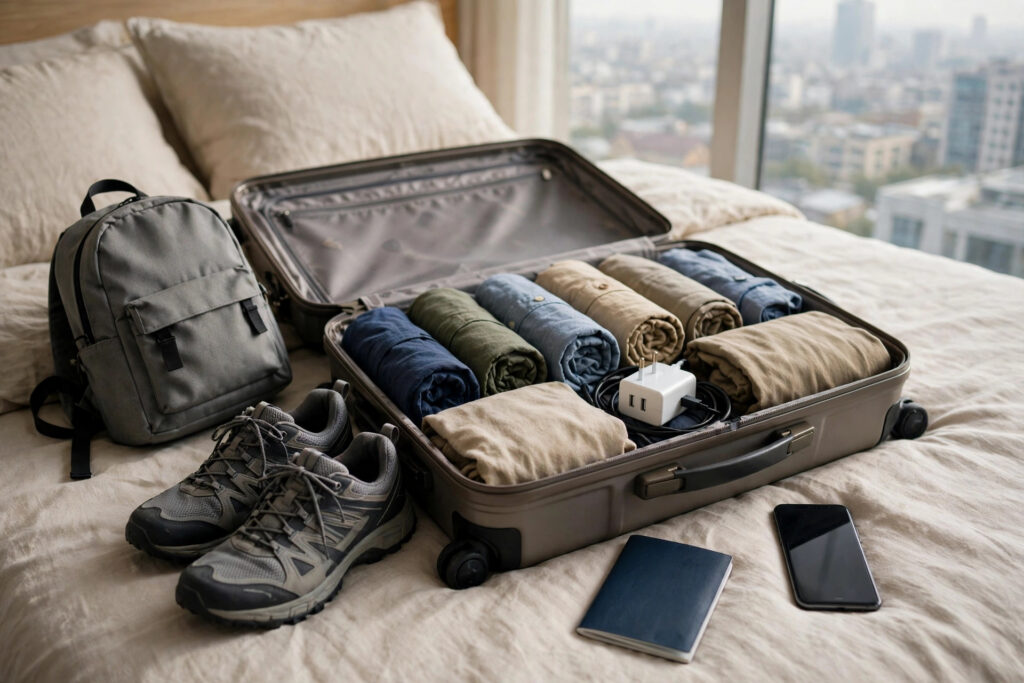
Packing for China is not about preparing for every possibility. It is about preparing to move: through large stations, up temple steps, and between cities that can feel like different climates on the same trip. The travellers who enjoy China most are rarely the ones with the biggest cases. They are the ones who can lift their bag, find what they need without unpacking everything, and walk comfortably for hours.
1. Choose one case you can actually carry
Start with the bag, because it decides everything else. A medium case of around 24 inches, plus a comfortable daypack, is the sweet spot for most first-timers. A very large case may be fine on a flight, but it becomes a problem on a train, in a small hotel lift, and on a pavement crowded with delivery scooters.
China Railway publishes a free carry-on allowance of 20 kg per adult on trains, with the length, width and height of each item on a high-speed train adding up to no more than 130 cm. In practice, staff rarely weigh ordinary suitcases, but the size rule matters: overhead racks suit cabin-sized bags, while larger cases go in the racks at the ends of the carriage, where space is limited. If you cannot lift your case onto a rack, it is too big. Our full rail guide explains how to travel by high-speed train in China.
Choose a case with four spinner wheels and packing cubes inside. Cubes let you pull out one day of clothes without turning the whole case inside out. Keep a change of clothes, chargers, and anything valuable in your daypack, in case your main case is delayed or stored out of reach.
2. Build a clothing system, not a wardrobe
China is large, and a single trip can include a cool morning in Beijing, a humid afternoon in Shanghai, and a cold evening on a mountain. Layers solve this better than bulky jumpers or a separate outfit for every day. Pack clothes you can mix, match, and rewear.
A workable core for ten to fourteen days is: four or five tops, two pairs of trousers, one smart outfit if you want it, a light waterproof jacket, a warm mid-layer such as a fleece, and sleepwear. Add a scarf, which doubles as a blanket on trains. Choose fabrics that dry quickly and do not crease badly, and avoid very short shorts for temple visits, where modest dress is more comfortable and more respectful.
Season changes the top layer, not the whole list. In winter in the north, add a warm coat, gloves, a hat, and thermal underlayers; Beijing and Harbin are genuinely cold, and wind on the Great Wall is colder still. In summer in the south, favour light, breathable fabrics, a sun hat, and clothes you can wash and wear again. If you are still choosing dates, our month-by-month guide to the best time to visit China will help you match clothing to region.
3. Shoes: the most important decision you will make
Bring one pair of well-broken-in walking shoes, and wear them on the plane. Most first-timers walk far more in China than they expect: old towns are best explored on foot, palace grounds are huge, and even a “short” visit to a scenic area can involve thousands of steps. New shoes are a mistake. So are flimsy sandals for a day that turns into a long walk.
If you want a second pair, make it light and flat: sandals for the hotel, or smart shoes for a nice dinner. Do not bring three pairs of heavy shoes. If your itinerary includes Jiuzhaigou, Huangshan, or another mountain area, make sure your main shoes have grip; stone steps are often smooth and slippery after rain.
4. Documents, money, and the things you must not lose
Keep your passport, visa documents if you need them, hotel confirmations, and insurance details in one place in your daypack — not in your checked case. Photograph your passport and keep a copy in your phone and email, separate from the original. Check your visa situation well before departure: many nationalities can now enter visa-free for a limited stay, but rules can change, so check the current position before you book. Our visa-free guide explains the framework, but it is not a substitute for checking your own case.
For money, China is largely cashless, and your phone will do most of the work. Set up Alipay or WeChat Pay before you leave if you can, and carry a bank card as a backup. Still bring a small amount of cash in renminbi for small vendors, rural areas, and the occasional machine that will not accept a foreign card. Our guide to paying in China as a foreigner walks through the setup step by step. Tell your bank you are travelling, and note the number to call if a card is blocked.
5. Power, adapters, and staying connected
Mainland China uses 220V electricity at 50Hz, with Type A, Type C, and Type I sockets. Most phone and laptop chargers are dual-voltage and only need a plug adapter: check for “100–240V” on the charger. An adapter changes the plug shape, not the voltage, so a device rated only for 110–120V should stay at home unless you have a proper voltage converter. Pack a compact adapter that covers Type I, plus a short multi-port USB charger so you can charge a phone, a power bank, and earphones from one hotel socket.
Bring a power bank and keep it in your daypack, not in checked luggage. You will use your phone for maps, payments, translation, and train tickets, and a flat battery at a station is an avoidable problem. For connectivity, sort out an eSIM or a roaming plan before you fly, and read our guide to staying connected in China before you choose. Download offline maps and your hotel addresses in Chinese characters: showing a driver the characters is far easier than pronouncing them.
6. Health, comfort, and the small things that save a day
Pack any regular medication in its original packaging, with a copy of the prescription, and keep it in your hand luggage. Bring a small first-aid kit: plasters, pain relief, stomach remedies, and anything you know you need. Pharmacies are easy to find in Chinese cities, but explaining a specific product in a hurry is not always easy.
The small items first-timers most often wish they had packed are unglamorous: tissues, hand sanitiser, a reusable water bottle, sunscreen, lip balm, and a light rain shell. Public toilets do not always provide paper, and tissues are easiest to have in your pocket. If you are sensitive to air quality, a comfortable mask is worth packing for hazy days in large cities.
7. What goes in the daypack
Think of your daypack as your kit for the hours between hotels. It should hold: passport, phone and charger, power bank, water, tissues, hand sanitiser, sunscreen, a snack, a rain shell, and your hotel address in Chinese. Add sunglasses and a hat, and leave room for anything you buy during the day.
A cross-body bag or a daypack with a zipped inner pocket is better than an open tote in busy stations and markets. Keep your phone in a zipped compartment on crowded metros, and avoid carrying your passport, all your cash, and all your cards in the same place.
8. What to leave at home
Leave behind the things that add weight without adding comfort. Full-size toiletries are the classic example: hotels provide basic toiletries, and everything else can be bought cheaply. Heavy guidebooks, multiple jackets “just in case”, and a large camera bag you will resent carrying are all better left behind.
Also leave any 110V-only appliance that needs a converter, and think twice about valuables you would worry about all day. If you are considering a drone or professional filming equipment, check the current local rules and restricted areas before you pack them.
9. Seasonal extras: a quick checklist
Use this as a final check once you know your dates and destinations:
- Winter in the north: warm coat, thermal layers, gloves, hat, scarf, lip balm, and shoes with grip for icy steps.
- Summer in the south: light breathable clothes, sun hat, sunscreen, insect repellent, rain shell, and a spare dry top.
- Spring and autumn: layers, a waterproof jacket, a scarf, and comfortable walking shoes.
- Mountain days: walking shoes with grip, rain shell, water, snacks, and sun protection.
- City days: comfortable shoes, power bank, tissues, and your hotel address in Chinese characters.
10. What is easy to buy in China
Do not over-pack for things China sells well. Toiletries, umbrellas, rain ponchos, phone chargers, adapters, snacks, bottled water, and basic clothing are widely available and often inexpensive. A supermarket trip on your first evening is a good way to top up anything you forgot.
Pack light, then enjoy the walking
The best packing list is the one you stop thinking about after the first day. One case you can lift, one daypack you can wear all day, shoes you trust, and the documents and chargers that keep you moving. If you are still shaping your route, read our first-timer mistakes to avoid and our itemised 2026 budget guide before you finalise your plans.
If you would like a packing list tuned to your exact route, season, and pace — rather than a general list — our concierge service can build one into your day-by-day plan, so you pack once and pack right.