
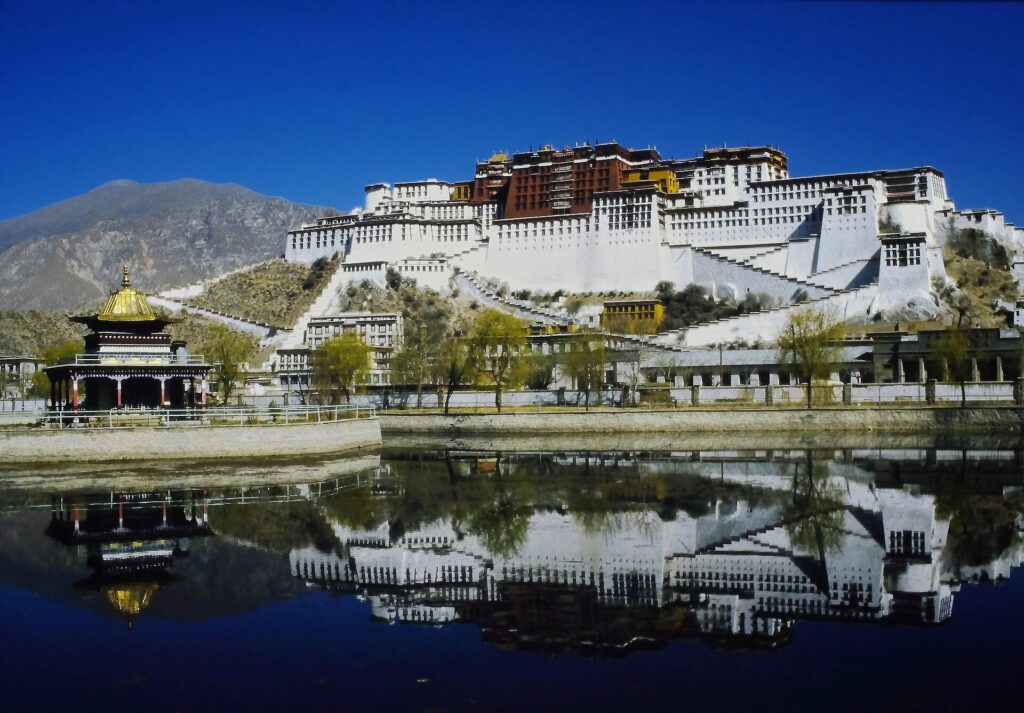
Lhasa sits at 3,650 metres on the Tibetan Plateau, and it behaves like it. The air is thin, the sun is fierce, and the Potala Palace — thirteen storeys of white and red rising over the old town — looks close enough to touch from almost anywhere in the city. Three days is right for a first visit: one to acclimatise, one for the Potala and the monasteries, and one to slow down and see how the city actually lives.
One thing to settle before anything else: foreign visitors cannot travel independently in Tibet. You need a Tibet Travel Permit arranged through a licensed, Tibet-registered agency, and you must travel with a guide on an organised itinerary. Our Tibet Travel Permit guide explains the process in full — start it four to eight weeks before you travel, and allow fifteen to twenty days for the permit itself.
Before you go: altitude, timing and getting there
Altitude shapes every plan in Lhasa. The city sits at 3,650 metres, and the Potala’s halls are higher still, at around 3,700 metres. Most visitors feel it on arrival: a headache, short breath on stairs, poor sleep on the first night. The standard advice is simple and worth following — rest on day one, drink far more water than usual, skip alcohol for the first couple of days, and save the Potala climb for day two or three. If you have heart or lung problems, speak to a doctor before booking.
The best window is May to October, when days are warmest and the skies clearest. July and August are the wettest and busiest months, and Potala tickets are hardest to get then. Winter is cold, bright and far quieter, with the palace ticket at half price.
Getting there is half the experience. Flights land at Lhasa Gonggar Airport, about 60 kilometres from the city centre, roughly an hour’s drive, with direct services from Chengdu, Xi’an and Beijing. The overland classic is the Qinghai–Tibet Railway: the run from Xining takes about 22 hours, and from Chengdu around 34. Your Tibet agency books the train or flight into Lhasa as part of the tour, since the permit is checked before boarding. Citizens of around 50 countries can enter China visa-free for up to 30 days (the scheme runs to 31 December 2026 — see our visa-free guide), but the waiver replaces the visa, not the permit: you still need the Tibet Travel Permit either way.
Day 1 — Arrive, rest, and walk the Barkhor
Do as little as possible on day one. Check in, drink water, eat lightly, and take a slow walk. Your hotel is likely near Barkhor Square, in the old town — stay there if you can, because everything on this itinerary is within walking distance.
In the late afternoon, walk the Barkhor circuit, the clockwise pilgrim route around the Jokhang Temple. It is barely a kilometre, but it is the best introduction to Lhasa there is: pilgrims turning prayer wheels and prostrating, stalls selling turquoise and yak-butter candles, monks and traders moving in the same slow stream. Walk it clockwise, at walking pace — a place of worship first and a sight second.
Step inside the Jokhang Temple itself, Tibet’s holiest shrine, founded in the 7th century and home to the revered Jowo statue of the Buddha. The rooftop gives you the classic view across the golden roofs to the Potala. Photography is not allowed inside the chapels; put the camera away and just look. Finish the day with thenthuk (hand-pulled noodle soup) or momos (steamed dumplings) near the square, and an early night.
Day 2 — The Potala Palace and the Sera debates
Day two is the big one. The Potala Palace was the winter palace of the Dalai Lamas, a UNESCO World Heritage Site since 1994, with more than a thousand rooms stacked thirteen storeys up Marpo Ri, the Red Hill. Reaching the halls means climbing about 1,080 steps and 110 vertical metres from the gate — at 3,700 metres, take it slowly and allow thirty to forty-five minutes just for the climb.
Tickets are the part to plan ahead. Entry is by timed, real-name slot booked through the palace’s official WeChat system, with slots released up to ten days ahead; in peak season they sell out within days, and your agency books them with your passport details. The full route (Line 1) costs ¥200 from May to October and ¥100 from November to April; a shorter route (Line 2) costs ¥100. Arrive an hour before your slot and allow about two hours inside. The palace closes on Mondays except on public holidays, and photography is banned inside the halls.
After lunch and a rest, head to Sera Monastery, about five kilometres north of the centre. Sera was founded in 1419 and is one of Lhasa’s three great Gelug monasteries. Its famous monk debates run in the courtyard from about 15:00 to 17:00, Monday to Saturday (no debates on Sundays). Monks pair off to argue Buddhist philosophy — one standing and questioning with sharp handclaps and stamps, the other seated and answering — a real part of monastic education, not a performance for visitors. Arrive by 14:30, keep out of the monks’ space, and keep your voice down. Entry costs about ¥50; a taxi from the Barkhor area takes fifteen to twenty minutes and costs roughly ¥20–30.
That evening, walk back to Barkhor Square. The Potala is floodlit after dark, and the square fills with locals circling the Jokhang as the light fades.
Day 3 — Drepung Monastery and the slow side of Lhasa
Start day three at Drepung Monastery, west of the city and the largest of Lhasa’s three great monasteries. It is quieter than Sera and more spread out, with whitewashed chapels climbing a hillside — come in the morning, when the chanting drifts out of the assembly halls and the crowds are thin.
Spend the afternoon at Norbulingka, the former summer palace of the Dalai Lamas, a walled garden of palaces, chapels and tree-lined paths that feels a world away from the old town’s bustle. Sit by the ponds, watch local families picnicking, and let the altitude catch up with you at last.
If you have a fourth day, the classic extension is a day trip to Yamdrok Lake, a startling turquoise lake about two hours’ drive southwest of Lhasa, usually combined with the Karola Glacier viewpoint. It needs an extra permit for travel outside Lhasa, which your agency arranges — another reason to settle the full itinerary before the permit application goes in.
Where to stay
Stay near Barkhor Square or along Beijing East Road in the old town. You will be within walking distance of the Jokhang, the Barkhor circuit and the teahouses, and your guide can collect you easily each morning. Guesthouses in the old town are characterful and cheap; the international-standard hotels sit a short drive east. Confirm with your agency that the hotel accepts foreign guests — most in Lhasa do, but check before you arrive, not at the front desk. Our guide to booking hotels as a foreigner explains the rule.
What three days in Lhasa costs
Tibet is not a budget destination, because the guided-tour requirement sets a floor under the price. A three-day Lhasa trip with a licensed agency, including the permit, guide, driver and mid-range hotels, typically runs from around ¥4,000–6,000 per person before flights or trains in — treat that as a planning range, not a quote. On top of that, budget roughly ¥150–250 a day for meals, taxis and small entry fees: the Potala at ¥200 in peak season is the biggest single ticket, Sera around ¥50, and a bowl of noodles ¥20–30. Alipay and WeChat Pay work in Lhasa as they do everywhere in China; see our payment guide for setting those up before you travel.
Practical tips for first-timers
- Sun protection is not optional. At 3,650 metres the UV is intense even on cloudy days. Bring strong sunscreen, sunglasses and a hat — and lip balm. See our China packing list for the rest.
- Ask before photographing people. Pilgrims and monks are not scenery. A smile and a gesture go a long way.
- Cash is a backup, not the plan. Mobile payment covers almost everything, but keep some small notes for temple donations and street stalls.
- Keep March flexible. Tibet has closed to foreign tourists for a short period in some recent years — permits were paused for roughly 1–18 March in 2024 and 1–19 March in 2025, with no closure reported in 2026. If you are planning a late-winter trip, confirm the position with your agency before booking flights.
- Do not plan the Potala for day one. It bears repeating: the climb at 3,700 metres is the hardest thing most visitors do in Lhasa, and it is far better on day two or three.
Lhasa rewards travellers who slow down. Three days gives you the palace, the temples and the debates, with enough slack to sit in a teahouse and watch the city go by — and that unhurried afternoon is usually the part people remember longest. If you want this itinerary shaped around your dates and how much walking you are comfortable with at altitude, that is exactly what our travel concierge service does. Want this itinerary tailored to your dates? Our Route Design ($180) turns it into a day-by-day plan — including the permit timeline, the Potala ticket booking and the train or flight into Lhasa, sorted before you commit to anything.