
Xi’an is the China you picture before you arrive: a walled old city, a buried army of clay soldiers, and noodles pulled to order in a market that has fed travellers for centuries. As Chang’an, it was the capital of successive dynasties and the eastern starting point of the Silk Road. Three days is the right amount of time here. It gives you one day for the Terracotta Army, one for the walled city itself, and one for the museums and pagodas that explain how the two fit together — without rushing from sight to sight.
This plan assumes you are staying inside or near the old city wall, close to the Bell Tower, where the metro lines meet and the food streets are. If you are coming from Beijing, read our Beijing in 3 days plan first: the two cities pair naturally, and the high-speed train between them takes around four and a half hours.
Day 1: Walk the wall, then eat your way through the Muslim Quarter
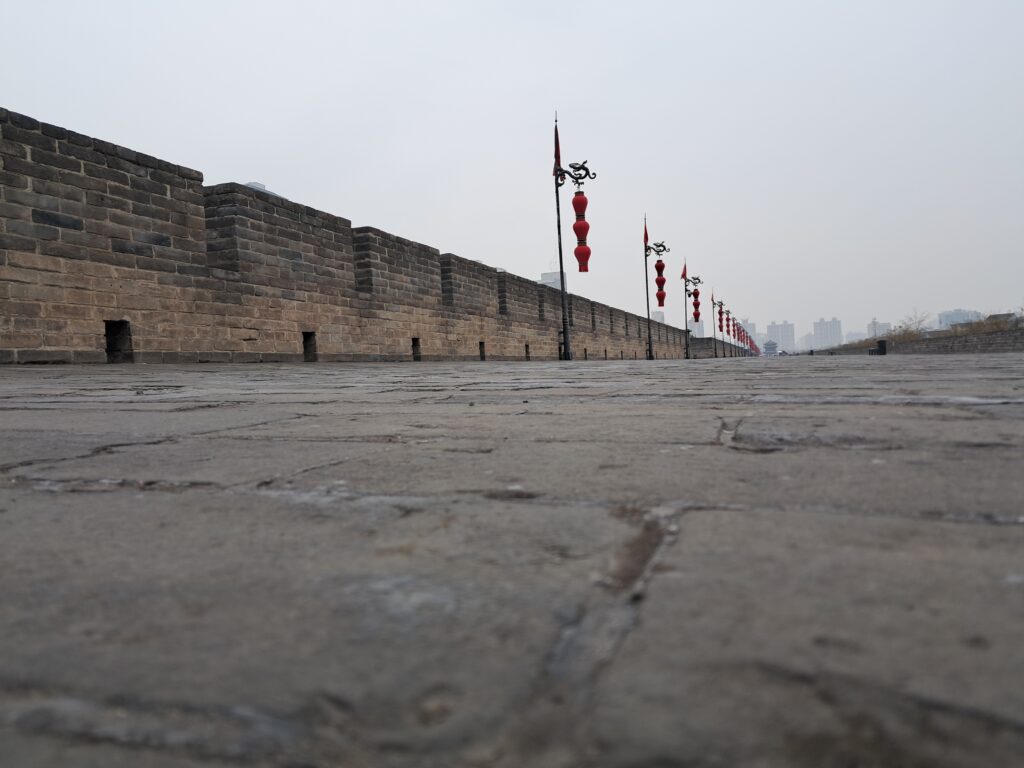
Start on the Xi’an City Wall, one of the best-preserved city walls in China. The full loop is about 14 kilometres, which is too much to walk in one go for most first-time visitors. Instead, walk or cycle the southern stretch from the South Gate (Yongningmen) towards the East Gate, then come down and continue on foot. Cycling is the easiest way to cover a longer section: bikes can be hired on the wall itself. Admission is reported at around ¥54; check before booking, as prices and entry windows can change around public holidays.
From the wall, head to the Bell Tower and Drum Tower, the pair of Ming-dynasty towers at the city’s historic centre. You do not need long inside either tower — the value is in standing at the crossroads they mark and getting your bearings.
Spend the rest of the day in the Muslim Quarter, the maze of lanes north of the Drum Tower. This is Xi’an’s great food neighbourhood, shaped by the city’s Hui Muslim community and by centuries of Silk Road trade. Come hungry and snack your way along: roujiamo (slow-cooked meat in a crisp flatbread), liangpi (cold noodles with chilli and vinegar), and yangrou paomo, the local ritual in which you tear flatbread into small pieces before it is returned to you in a rich lamb soup. Order one dish at a time, share everything, and keep some appetite for the next lane. Street food here is best paid for with a phone: see our guide to paying in China as a foreigner before you arrive, so Alipay or WeChat Pay is already working.
Day 2: The Terracotta Army, done properly
Give the Terracotta Army a full morning, and go early. The site — officially the Emperor Qinshihuang’s Mausoleum Site Museum — sits about 40 kilometres east of central Xi’an, in Lintong District, so allow roughly an hour each way by taxi or ride-hailing. Our detailed Terracotta Army tickets and visit guide covers the booking steps in full; the essentials for 2026 are these.
Admission is ¥120, which covers the three warrior pits and Lishan Garden, with a shuttle between the two areas. Opening hours are 8:30am to 6:30pm from 16 March to 15 November, and 8:30am to 6pm from 16 November to 15 March, with last entry earlier than closing. Tickets use a real-name reservation system, so book ahead — ideally several days in advance — and bring the same passport you booked with. Weekends and Chinese public holidays sell out first, and arriving at opening time is the single best way to see Pit 1 before the halls fill.
Inside, start with Pit 1, the vast main formation of infantry, then move to Pit 2, with its chariots and cavalry, and Pit 3, the small command post. Walk the full perimeter of Pit 1 rather than stopping at the first viewpoint: the rear sections, where excavation is still under way, show warriors half-emerged from the earth and give a much better sense of the scale of the work. Afterwards, take the shuttle to Lishan Garden for the bronze chariots, which are among the finest objects in the whole complex. Allow three to four hours for the site in total.
Back in the city, keep the evening light: dinner in the Muslim Quarter, or a quiet stretch of the wall at dusk, when the lanterns come on.
Day 3: Pagodas, a great museum, and the Tang city at night
Begin at the Big Wild Goose Pagoda and Daci’en Temple in the south of the city. The pagoda was built in 652, in the Tang dynasty, to house Buddhist scriptures brought back from India by the monk Xuanzang — the journey later retold in the classic novel Journey to the West. The temple and the pagoda climb are ticketed separately, and recent listings disagree on the temple price, with figures from around ¥10 to ¥40 reported alongside a climbing ticket of roughly ¥25. Treat those numbers as a guide only and check the live price on the day before booking. The climb itself is steep, with narrow stone stairs and no lift, but the view from the top is the best orientation to the southern half of the city. The North Square fountain shows are free but seasonal and weather-dependent, so do not build your evening around a timetable you found months in advance.
Next, go to the Shaanxi History Museum, a short distance away. It is one of the best museums in China for understanding Xi’an: bronzes, Tang gold and silver, and ceramics laid out in dynastic order, so the warriors of Day 2 and the pagoda of this morning start to connect. Entry is free, but you must reserve ahead, and the museum is closed on Mondays — check the current schedule before you plan around it. If you only have time for one museum in Xi’an, make it this one.
Finish the day at the Grand Tang Dynasty Ever Bright City, the pedestrian street beside the pagoda. By night it is bright, loud, and theatrical, with performers, light displays, and food stalls along a Tang-themed promenade. It is not a quiet historic site, and that is the point: after two days of archaeology, it shows how Xi’an presents its own history to itself.
When to go, where to stay, and how to get there
When to go. Spring (April to May) and autumn (September to October) are the most comfortable seasons, with mild days and clearer skies. Summer is hot and crowded, especially around school holidays; winter is cold but quiet, and the Terracotta Army halls are indoors, so a winter visit is perfectly workable if you dress warmly for the wall.
Where to stay. Stay near the Bell Tower or the South Gate, inside the wall if you can: within walking distance of the Muslim Quarter, on the metro, and able to start a wall walk without a taxi ride first.
How to get there. The high-speed train from Beijing is the simplest arrival for most first-time visitors: frequent G-trains run from Beijing West to Xi’an North in roughly four and a half to five hours, with second-class fares typically in the region of ¥515–¥615 depending on the service — check the live timetable and price on 12306 or your booking app before you travel, as both vary by departure. Xi’an North is about 30 minutes from the city centre by metro. If you are flying, Xi’an Xianyang International Airport is served by airport buses and taxis; allow generous time for the transfer. Our China high-speed rail guide explains how foreign visitors book trains with a passport.
Practical tips for first-time visitors
- Book the big three ahead: the Terracotta Army, the Shaanxi History Museum, and your Beijing–Xi’an train. Everything else in this plan can be decided on the day.
- Carry your passport to ticketed sights. Real-name reservations mean the document you booked with is the document you enter with.
- Bring comfortable shoes. The wall, the museum halls, and the Muslim Quarter lanes add up to a long day on your feet, and the wall surface is uneven in places.
- Check visa rules early. Many nationalities can now enter China visa-free for up to 30 days, and others may qualify for the 240-hour transit scheme — see our China visa-free guide and confirm your own eligibility before booking anything non-refundable.
- Do not try to add Mount Hua as a day trip on top of this plan unless you drop something else. The mountain deserves its own day, and a rushed visit after the Terracotta Army is the most common way visitors exhaust themselves in Xi’an.
Three days in Xi’an gives you the arc of Chinese history in a single city: a buried army from the first empire, a Ming wall you can walk, a Tang pagoda, and a food culture that still tastes of the Silk Road. It also fits neatly into a longer first trip — pair it with Beijing before it, or with Chengdu afterwards, using our two-week China itinerary as the frame. If you would like this plan shaped around your own dates, pace, and food preferences, our concierge service can do that for you. Want this itinerary tailored to your dates? Our Route Design ($180) turns it into a day-by-day plan, with the bookings and the order of sights worked out for you.
Photo: Xi’an City Wall, by Ideophagous / Wikimedia Commons (CC BY-SA 4.0). Prices and hours checked against 2026 listings; confirm before booking.