
Last updated: November 24, 2026
Why people come
The gorge is one of the deepest in the world: roughly 3,790 m from river to peak by most accounts. The Jinsha (upper Yangtze) is squeezed between Jade Dragon Snow Mountain on one side and Haba Snow Mountain on the other. The classic experience is a ridge-line walk with the river roaring far below, farmhouse guesthouses with mountain views, and an easy bus ride from Lijiang. If you are already planning Lijiang Old Town and Jade Dragon Snow Mountain, the gorge fits neatly as a one-night detour.
First: what is actually open in 2026
This is the part most older blog posts get wrong. Reports we checked in November 2026 describe three layers, and they do not all say the same thing:
| Part | Reported status | What to do |
|---|---|---|
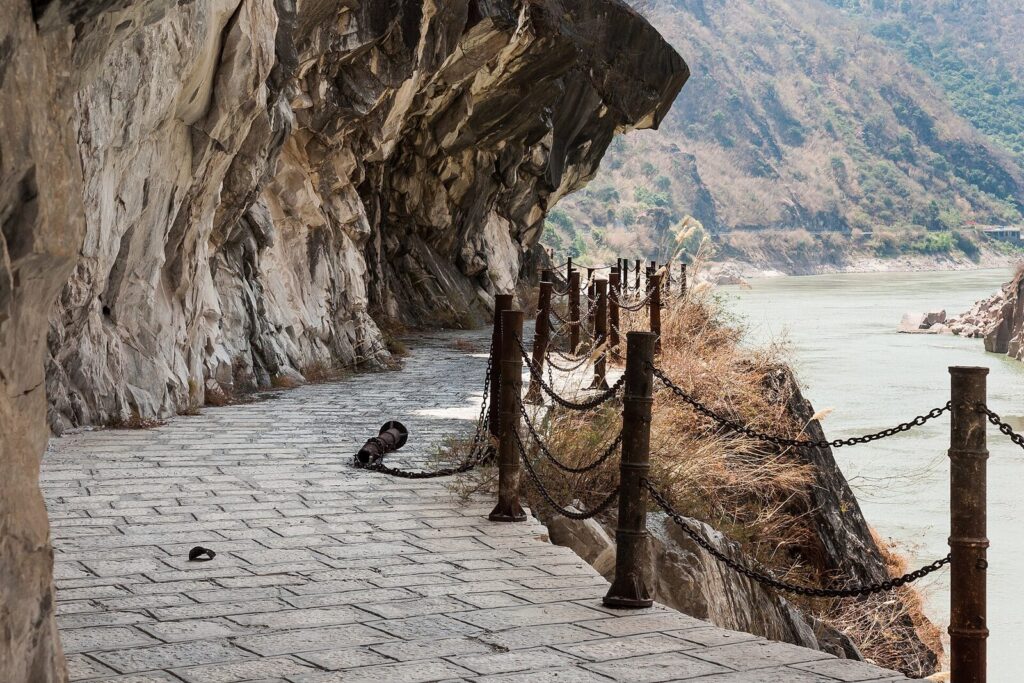
| Upper Gorge scenic area (boardwalk, viewpoint) | Open, with weather closures in the rainy season; one site reports a flood closure on 18 July that reopened on 23 July 2026 | Fine for a half day; confirm same-day status with your hotel |
| High Trail (Qiaotou to Tina’s) | Reported as officially designated no-entry since 2024 and restated in later notices; reports say hikers still walk it and enforcement varies | Ask your Lijiang hotel or a trailhead guesthouse the day before; have a Plan B |
| River-level shortcuts (Sky Ladder, Teacher Zhang path) | Reported closed after fatal accidents | Do not use them, and ignore anyone offering a paid shortcut |
We cannot verify the legal position for you, and it may change between our update and your trip. If the trail is closed when you arrive or locals advise against it, take the Upper Gorge option instead.
Option A: Upper Gorge viewpoint (half day)
This is the low-effort version. You pay for entry and usually a shuttle or escalator, walk the boardwalks to the river, and return. Ticket prices vary a lot by source and platform, so treat these as ranges and confirm at the booth:
- Entry: about ¥35-65 (US$5-9) depending on the source and side of the gorge.
- Shuttle or escalator extras: roughly ¥35-75 (US$5-10).
- Time: 2-3 hours on site, plus the transfer from Lijiang (about 2 hours each way).
Add the typical ¥50 (US$7) Lijiang Old Town maintenance fee if you have not already paid it; it is valid for a year.
Option B: the two-day High Trail
The route in numbers
| Item | Typical figure |
|---|---|
| Distance (Qiaotou to Tina’s) | About 18-22 km depending on the source |
| Walking time | Day 1: 5-6 hours; day 2: 2-5 hours |
| Hardest part | The 28 Bends, a steep switchback climb of roughly 440-500 m |
| Highest point | About 2,640 m, so altitude sickness is unlikely |
| Gorge ticket (reported) | ¥45 (US$6) |
Day 1: Qiaotou to the guesthouses
- Take a morning bus from Lijiang (see below) and ask for Qiaotou (桥头), not “Tiger Leaping Gorge”. The latter can take you to a different tourist entrance.
- Road works have moved the practical start uphill to Changsheng Village in some reports; a short local ride from Qiaotou costs about ¥20-40 (US$3-6).
- Climb the 28 Bends slowly. Water stalls appear roughly every 45 minutes.
- Above the Bends the path levels out along the mountainside with views toward Jade Dragon Snow Mountain. Most walkers sleep at Naxi Family, Tea Horse or Halfway guesthouse.
Day 2: down to Tina’s
The second day is shorter, with a balcony path and a steep descent to the road at the Middle Gorge. From Tina’s you can catch buses to Shangri-La (around ¥55, reported times from about midday) or back to Lijiang (around ¥50 from about 13:00).
Where to sleep and what it costs
| Guesthouse (reported) | Dorm bed | Private room |
|---|---|---|
| Naxi Family | about ¥57 (US$8) | about ¥168-182 (US$23-25) |
| Tea Horse | about ¥47 (US$7) | about ¥110-145 (US$15-20) |
| Halfway | about ¥78 (US$11) | about ¥208 (US$29) |
| Tina’s | about ¥57 (US$8) | about ¥228-242 (US$32-34) |
One itemised 2026 budget put the whole two days at roughly ¥1,200 (about US$165) with a private view room, meals, bus fares and the gorge ticket; dorm beds cut that sharply. Pay with Alipay or WeChat Pay; our China payment guide explains how to set both up as a foreigner.
Getting there from Lijiang
| Method | Time | Cost |
|---|---|---|
| Public bus, Lijiang bus station to Qiaotou | 2-2.5 hours | About ¥25-45 (US$3.5-6) |
| Any Lijiang-Shangri-La bus (ask to be dropped at Qiaotou) | 2-2.5 hours | About ¥30 (US$4) |
| Shared van or private car via a guesthouse | 1.5-2 hours | About ¥100-200 per person (US$14-28) |
Morning buses leave around 8:00-9:30 and times shift by season, in winter sometimes only the later one. You may need your passport to buy a ticket. The bus station is about a 15-minute walk south of the Old Town; a taxi from the train station is around ¥15. For the Dali-to-Lijiang leg and booking trains, see our China train guide.
Luggage: a common trick is to tell the driver to send your big bag on to the Middle Gorge (Tina’s) and walk with a daypack. Read our luggage storage and forwarding guide for the general options.
Best time to go
- Best: April-May (dry, clear) and often September-November.
- Avoid: June-September brings rain, with rockfall, landslides and swollen waterfalls. Do not hike after heavy rain.
- Winter: cold at altitude, fewer buses, some guesthouses closed.
The wider seasonal picture is in our best time to visit China guide.
Pros and cons
| Pros | Cons |
|---|---|
| Dramatic scenery, easy from Lijiang, cheap sleeping | High Trail legal status is unclear and may be closed |
| Clear yellow-arrow route, 4G on most of it | Steep 28 Bends climb; rockfall risk in rain |
| Upper Gorge works for any fitness level | Conflicting ticket prices and limited English booking |
What to pack
- Daypack, 1.5-2 L of water, trail snacks, sun protection, rain jacket.
- Sturdy shoes: the path is rocky and uneven.
- Offline maps and a working data connection; see our eSIM guide.
- Cash is rarely needed, but keep a few notes as a backup to mobile payment.
Sample plans
- Easiest: Lijiang base, a day trip to the Upper Gorge, back by evening.
- Classic: Lijiang, morning bus to Qiaotou, hike day 1, sleep at the guesthouse, finish at Tina’s on day 2, then bus to Shangri-La or back to Lijiang.
- Yunnan loop: Kunming, Dali, Lijiang, gorge, Shangri-La. Our 7 days in Yunnan plan shows the pacing.
FAQ
Is the High Trail closed?
Several 2026 sources describe an official no-entry designation, while also reporting that people still walk it. Because that can change, ask locally before you go.
Do I need a guide?
The route is marked with yellow arrows and most walkers go independently. Any shortcut to the river is a separate matter and is reported as closed.
Can I do it in one day?
Fast walkers can, but you then need to plan the last bus out carefully. Two days is far more comfortable.
Is altitude a problem?
The highest point is about 2,640 m, so serious altitude sickness is unlikely, though Lijiang itself sits above 2,400 m.
Can I pay by card?
Guesthouses and bus counters mostly expect Alipay or WeChat Pay.
Want help planning it?
Our travel concierge service can help build a Yunnan route, check current trail and transport status, arrange bookings and translation, and support you on the road. Pricing is a custom quote based on your trip. Message us on WhatsApp or use the concierge page to get started.