
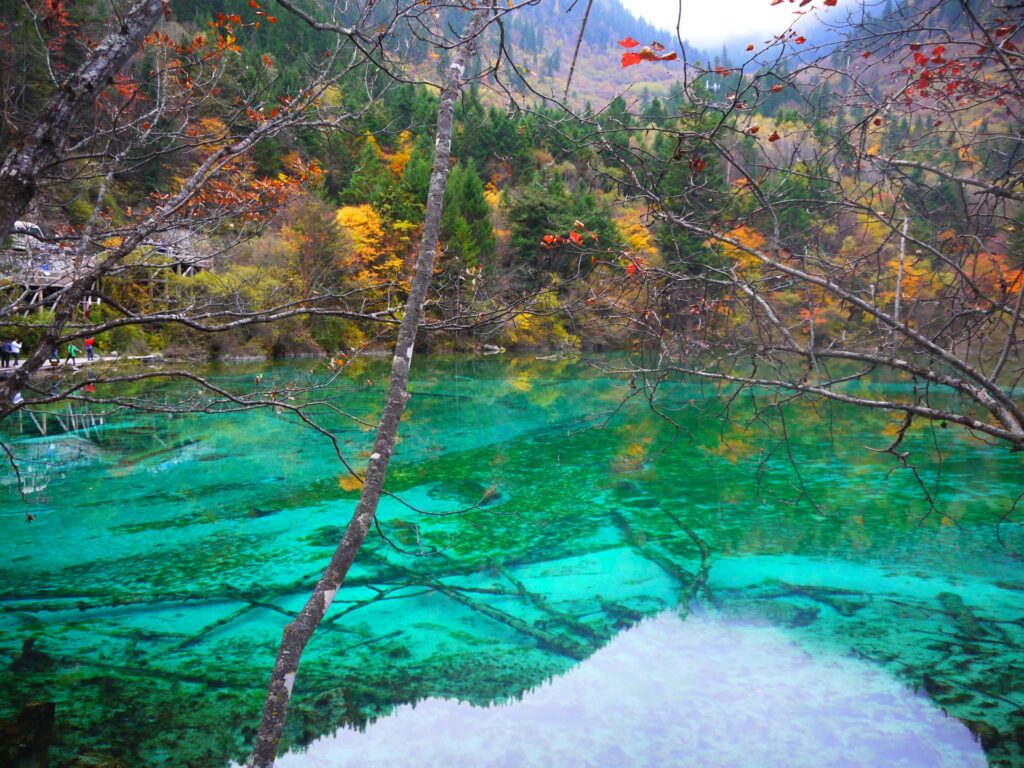
Jiuzhaigou looks photoshopped in person. Stand on the boardwalk at Five Flower Lake and the water is turquoise, teal, and milky jade all at once, with fallen trunks visible twenty metres down and yellow leaves drifting across the surface. No filter — the colour comes from limestone-filtered water and lakebed algae, and it does this all year.
The park is a Y-shaped network of valleys in northern Sichuan, about 60 km of road between forested ridges at 2,000–3,100 m. The three valleys each have their own character: Rize Valley holds the famous lakes, Zechawa Valley goes highest, and Shuzheng Valley has the waterfalls and gentlest scenery. One day is the minimum and works if you move efficiently; two days is the sweet spot — it lets you see everything at a civilised pace and returns you for a second look at your favourite lake.
Tickets and booking: read this first
Jiuzhaigou runs a real-name advance reservation system — there are no on-site ticket sales. You book ahead and enter with the document you registered with.
- Peak season (1 April–15 November): entrance ¥190 + sightseeing bus ¥90 = ¥280 per adult. Optional insurance ¥10.
- Off-season (16 November–31 March): entrance ¥80 + bus ¥80 = ¥160 per adult.
- Hours: 07:30–18:00 in peak season, 08:30–18:00 off-season. Latest entry is 14:00 in both seasons.
- Daily cap: 41,000 visitors in peak season — tickets genuinely sell out from May through October.
- Children under 6 or under 1.2 m go free (bus included). Seniors get free entrance, though the bus ticket still applies. Students 7–18 get half-price entrance with ID.
- A second-day visit in peak season requires a new full ticket; in off-season, re-entry costs ¥20 plus the ¥80 bus.
Book 7–14 days ahead in peak season, a few days ahead off-season. Mainland-ID holders use the official “Jiuzhaigou” WeChat mini-program. Passport holders can’t use that system directly — the practical route is a Jiuzhaigou ticket package or day booking on Trip.com, which handles the reservation and entry formalities for you. If you’re already in Zhangzha (the town at the entrance), the ticket office can help passport holders, but same-day tickets aren’t guaranteed.
Park rules that catch people out: drones are banned (fines from ¥5,000), smoking is banned park-wide, pets are not allowed, and there is no overnight accommodation inside the valley — you visit inside and sleep outside, no exceptions. Food is only sold at Nuorilang Centre between 10:30 and 14:00, so bringing your own lunch and water is allowed and wise.
Getting there: the high-speed rail changed everything
The fastest route is no longer a flight — the Sichuan–Qinghai railway reached the region in 2024 and transformed the trip.
- High-speed train (best option): Chengdu East → Huanglong Jiuzhai station in about 2 hours. From the station, a direct shuttle (around ¥30) runs roughly 1.5–2 hours to the park entrance. Train seats on the Sichuan–Qinghai line sell out on weekends and holidays — book on Trip.com or 12306 as early as you can; our China High-Speed Rail Guide covers the booking drill.
- Flight: Direct to Jiuzhai Huanglong Airport, then about 1.5 hours to the entrance. Flights are weather-dependent at this altitude and cancellations are common.
- From Huanglong: If you’re combining both sites, a public shuttle connects Jiuzhaigou and Huanglong daily — ¥47 each way, departing Jiuzhaigou Bus Station at 07:40 and returning at 15:30. Or simply alight at Huanglong Jiuzhai station on the way in, since it sits just 26 km from Huanglong.
Sort money and connectivity before leaving Chengdu — How to Pay in China as a Foreigner and our eSIM guide.
Day 1 — Rize Valley: the headline lakes
Enter early and head straight for the top of Rize Valley — the sightseeing buses work like a hop-on-hop-off network, and Nuorilang Centre is the interchange where the three valley lines meet.
Start at Five Flower Lake (五花海). This is the valley’s signature: a shallow, intensely coloured lake where mineral deposits paint the shallows in patches of blue, green, and gold. Go in the morning when the sun is high enough to light the water but the crowds are still thin — the Tiger Mouth viewing platform gives the best angle. This is also the scene we covered in Jiuzhaigou in Autumn: October turns the hillsides red and gold and the lake into a mirror of them.
Walk the boardwalk down to Pearl Shoal Waterfall (珍珠滩瀑布) — a wide, frothy cascade over a limestone terrace — then loop back to Mirror Lake (镜海), which lives up to its name on calm mornings. Between the bus stops there are over 80 km of wooden boardwalks, so walk one stretch and ride the next; the trails get you close to the smaller falls the bus just drives past.
Eat at Nuorilang Centre around midday (remember: it’s the only food in the park), then spend the afternoon in the lower part of Rize — Arrow Bamboo Lake and Panda Lake, which is just a very blue lake, pandas aside. Exit on the last bus and you’ll have seen the best valley in full.
Day 2 — Zechawa and Shuzheng: height and waterfalls
Zechawa Valley (则查洼沟) is the long, quiet arm. The bus climbs to Long Lake (长海) at about 3,100 m — the highest, largest, and deepest lake in the park, backed by snow-dusted peaks in winter. Twenty minutes’ walk downhill is the Five-Color Pond (五彩池), the valley’s jewel: small, impossibly blue, and best around midday when the sun hits it directly. Zechawa takes half a day, crowds included.
Descend to Nuorilang and cross into Shuzheng Valley (树正沟) for the afternoon. This is waterfall country. Nuorilang Waterfall (诺日朗瀑布) is the widest travertine waterfall in China — 270 m across, thundering in summer, and in deep winter it freezes into a curtain of blue ice that is worth the off-season trip alone. Walk down past the Shuzheng Lakes, a terraced chain of 19 lakes connected by small falls, and Spark Lake (火花海), which glitters at sunrise. The Shuzheng boardwalk is the gentlest in the park and the best place to slow down and just watch the water.
That’s why two days beats one: a second morning lets you return to whichever lake the weather suits.
Altitude, weather, and what to pack
The park sits at 2,000–3,100 m — thin enough air to notice, but most people are fine. Take it slow on arrival, drink more water than usual, and don’t sprint the boardwalk stairs at Five-Color Pond on your first morning. Coming from sea level? Sleep in Zhangzha the first night instead of rushing straight in.
- October: peak foliage season, peak crowds, peak prices. Book everything early.
- May–June: snowmelt fills the falls, everything is green, crowds are manageable.
- July–August: lush and rainy; bring a rain shell.
- November–March: ¥160 tickets, frozen waterfalls, blue-ice lakes, and a fraction of the visitors. Cold — pack a proper winter layer.
- Golden Week (1–7 October): the park hits its 41,000 cap. Go any other week.
Sunscreen matters at this altitude even in winter; a light rain jacket is worth carrying year-round.
Where to stay and eat
You stay outside the entrance in Zhangzha town — there is no in-park accommodation, full stop. Hotels cluster within walking distance of the entrance gate; anything within 1 km lets you be at the gate for opening. Mid-range hotels run ¥300–600 per night; in October, book weeks ahead.
Zhangzha’s restaurants serve Sichuan food toned down for tourists plus Tibetan touches — yak meat, barley cakes, butter tea. For the full-strength version, see our Chengdu food guide. Inside the park, eat at Nuorilang Centre (10:30–14:00) or bring your own — most experienced visitors do both.
Budget-wise, Jiuzhaigou is a moderate stop on a China trip: two days of tickets (¥280/day in peak season), a mid-range hotel, and meals run roughly ¥600–900 per person per day including transport from Chengdu. The full breakdown for a China trip is in our 2026 cost guide.
Practical notes
- Visa: Around 50 nationalities get 30-day visa-free entry as of 2026. The full picture: China Visa-Free Transit in 2026.
- Navigation: Google Maps doesn’t work in mainland China. Amap (高德地图) covers the park trails and Zhangzha town.
- Connectivity: Have your eSIM working before the train leaves Chengdu — signal inside the valleys is patchy.
- Cash: Not needed. Alipay/WeChat Pay work at the gate and everywhere in Zhangzha.
- Combining sites: Huanglong’s travertine pools pair naturally with Jiuzhaigou — the ¥47 shuttle makes it a clean add-on day.
Fitting Jiuzhaigou into a bigger trip? It’s the natural high-altitude chapter between cities — pair it with the food energy of Chengdu, the stone pillars of Zhangjiajie, or slot it into our two-week China itinerary as the wild middle days.
If you’d rather not juggle train tickets, shuttle bookings, and park entry across two towns and a railway station yourself, our travel concierge builds the route around your dates, books the tricky tickets, and stays on WhatsApp while you travel — so the lakes are the only blue thing you have to think about.