
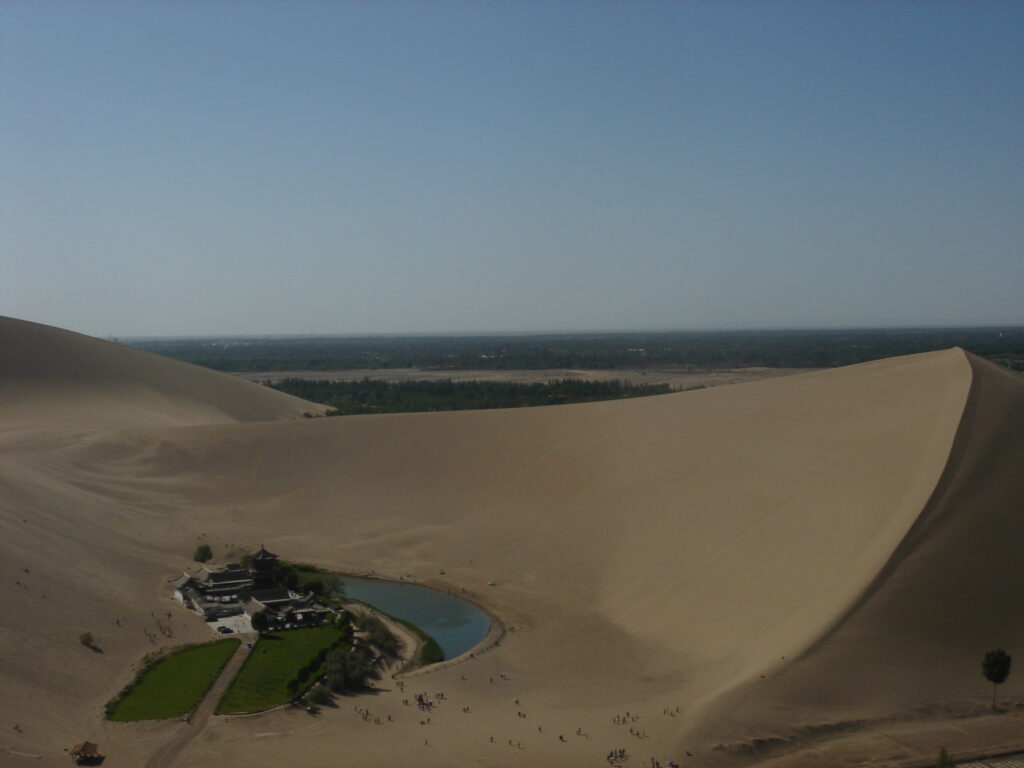
Dunhuang is the Silk Road stop that still feels like a frontier town. For more than a thousand years, merchants, monks and soldiers crossed the desert to reach this oasis on the edge of the Gobi, and the art they left behind is still here: a cliff face filled with Buddhist grottoes, a crescent-shaped spring ringed by singing dunes, and a night market that smells of cumin and grilled lamb. Three days is the right amount of time: one full day for the Mogao Grottoes, one for the desert, and one for the old passes and museums that put both into context.
Dunhuang rewards a slower pace. The sights are spread out, the summer heat is serious, and the grottoes cannot be rushed: tickets are timed, groups are guided, and daily visitor numbers are capped. Plan the grottoes first, then build everything else around that booking. If you are coming from Xi’an, the eastern starting point of the Silk Road, Dunhuang is the natural next chapter — the same route, a thousand kilometres further west, and a very different landscape.
Day 1: The Mogao Grottoes, done properly
Start at the Mogao Grottoes, about 25 kilometres south-east of Dunhuang city. This is one of the great art sites in the world: 492 surviving grottoes, cut into a cliff above the Daquan River, holding some 45,000 square metres of murals and more than 2,000 painted statues, created over roughly a thousand years from the fourth century onwards. Traders funded the caves as thanks for surviving the desert crossing; monks and painters added to them for centuries afterwards. The result is a record of Buddhism, trade and daily life along the Silk Road, in colours still startlingly vivid in the dark.
Book well ahead. Peak-season tickets are capped at around 6,000 a day, and reservations open about 30 days in advance through the official Mogao booking site and its WeChat service — use those official channels, and be wary of third-party sellers promising guaranteed tickets. Bring your passport: it is needed for the real-name booking and for entry. A standard peak-season ticket is reported at around ¥238–258, covering two films at the Digital Exhibition Centre, a shuttle to the grottoes, and a guided visit to eight caves; a cheaper emergency ticket, around ¥100, covers four caves if standard tickets have sold out. Foreign-language guided visits cost more and are limited in number, so book early if you want one. Prices and ticket types change, so check before booking.
Allow half a day, and follow the sequence rather than fighting it. You start at the Digital Exhibition Centre, watch the films, then take the shuttle to the cliff. Inside, you move with a guide from cave to cave in low light, and you will only see a selection of the open caves — that is deliberate, to protect the murals. Photography is strictly forbidden inside the caves, and bags and cameras go into lockers at the centre. Without a camera in your hand, you actually look at the flying apsaras, the thousand-Buddha patterns and the great reclining Buddha, and listen to the guide explain which dynasty painted what. Save your camera for the desert.
In the afternoon, visit the Dunhuang Museum, free or very cheap, which explains the oasis, the Silk Road passes and the famous Library Cave, where tens of thousands of manuscripts were sealed away in the early eleventh century and rediscovered in 1900. Then head to the Shazhou Night Market for dinner: donkey-meat yellow noodles, hand-pulled noodles, lamb skewers, and apricot-peel juice, a sweet-tart local drink sold by the cup. Eat one thing at a time, share everything, and pay by phone — see our guide to paying in China as a foreigner before you arrive, so Alipay or WeChat Pay is already working.
Day 2: Singing dunes and Crescent Lake
Spend your second day at Mingsha Shan and Crescent Lake, about 6 kilometres south of the city. Mingsha Shan, the Singing Sand Dunes, is a ridge of sand that can reach 170 metres high; on a dry, windy day the sliding sand really does hum. At its foot sits Crescent Lake, a spring that has survived in the desert for centuries, ringed by reeds and pavilions. The contrast is the whole point: golden dunes on one side, green water on the other.
Go late in the afternoon if you can. The light is softer, the heat eases, and the sunset from the top of the dunes is the classic Dunhuang photograph — climb the wooden steps to the ridge, look back over the lake and the pavilions, and you will understand why this image is on so many postcards. Admission is reported at around ¥110 in peak season (April to October) and ¥55 in the off-season, and the ticket is valid for three days with re-entry, so you can return for a sunrise if the first evening is hazy. Camel rides, sandboarding and dune buggies are all available at extra cost; a camel ride of about an hour and a half is reported at around ¥100. Take the camel ride if it appeals to you, but do not feel you must: walking the ridge and sitting quietly by the lake gives you the same landscape without the queue.
Pack for the desert even if the morning looks calm: sun protection, a hat, sunglasses, water, and shoes you can shake sand out of. A light scarf or mask helps when the wind picks up, and the sand-proof shoe covers at the entrance save a surprising amount of emptying later. Stay on the marked paths around the lake: the fragile edge of the spring is protected for a reason.
Day 3: Old passes, desert sculpture, or a slower morning
On your third day, choose between the desert frontier and a slower city morning. The ambitious option is a day trip west to Yumen Pass and the Yadan National Geological Park, sometimes called the Devil City. Yumen Pass — the Jade Gate — was one of the great gateways of the Han-dynasty frontier, and its ruined walls still stand in open desert. Yadan, further west, is a landscape of wind-carved yardang rock formations, shaped over thousands of years into ridges, castles and ships. You will need a hired car or a driver for the day, as public transport to both is thin; agree the price and the route in advance, bring water and sun protection, and expect a long, dusty, memorable day.
The gentler option is to stay in town: revisit Crescent Lake in the morning light on your three-day ticket, browse the souvenir streets for silk scarves and mural reproductions, and try the daytime food stalls you missed on the first evening. If you have only two days, drop Day 3 and keep Days 1 and 2 intact — the grottoes and the dunes are the two sights you should not cut.
Getting there and getting around
Dunhuang is remote, and that is part of its appeal, but it does mean the journey needs planning. The simplest route for most first-time visitors is to fly to Dunhuang Mogao International Airport (DNH), with direct flights from Xi’an, Lanzhou, Beijing and other cities, some of them seasonal. By rail, allow a full travel day: trains run from Lanzhou and Jiayuguan, and from Xi’an with a change, so check the live timetable on 12306 or through our China high-speed rail guide before you fix your dates. Dunhuang railway station is about 12 kilometres from the city centre, and the Mogao Digital Exhibition Centre is a separate stop again, so budget for taxis or buses between each leg rather than assuming you can walk it.
Stay in the city centre, near the night market, where hotels, restaurants and taxi stands are concentrated. The grottoes, the dunes and the passes are all day trips from there. Book a hotel licensed to host foreign guests — see our guide to booking hotels as a foreigner — and confirm your Mogao ticket date before you confirm a non-refundable room, not the other way round.
When to go, and what to watch for
Spring (April to May) and autumn (September to October) are the sweet spots: warm days, cooler evenings, and the desert at its most comfortable. Summer is peak season and genuinely hot, with strong sun and occasional sandstorms; winter is cold and quiet, with lower prices, fewer visitors, and sometimes extra caves open at Mogao, but shorter days and the chance of disrupted access in bad weather. Whenever you go, book the grottoes first, carry your passport for ticket checks, and keep your first day flexible: if a sandstorm or heavy rain closes a site, the city museums and the night market still give you a full day.
Dunhuang is not a place to tick off quickly. Stand in a dark cave looking at a thousand-year-old mural, then walk out into blinding desert light, and you understand what the Silk Road actually meant: months of sand, a spring that saved lives, and art made by people grateful to have arrived. Give it three days, and it will stay with you longer than almost anywhere else in China.
If you want this kind of route shaped around your own dates — which caves to prioritise, how to pair Dunhuang with Xi’an or Lanzhou, and where to stay so the grottoes booking actually works — our concierge service can put it together for you. Want this itinerary tailored to your dates? Our Route Design ($180) turns it into a day-by-day plan.