
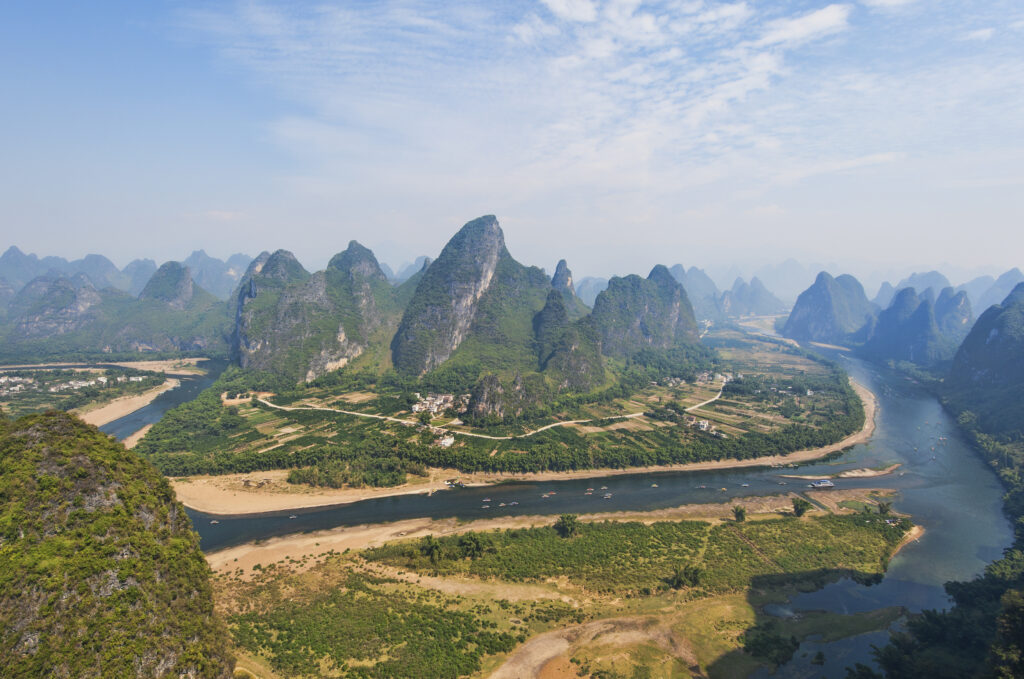
You know the photograph: limestone peaks rising out of green water, a bamboo raft drifting past, mist softening the ridgelines behind. That image is the Li River between Guilin and Yangshuo, and it is one of the rare “iconic China” shots that looks almost exactly like the postcard in person.
First things first, because most first-timers get this wrong: Guilin and Yangshuo are not the same place. Guilin is the city — the airport, the train stations, the parks. Yangshuo is a small town about 65 km south, sitting in the middle of the scenery that made the region famous. You fly into Guilin and head to Yangshuo. Four days covers it properly; two works if you’re in a hurry, five lets you add the Longji rice terraces.
Day 1 — Guilin city: ease in
Give Guilin itself one day. Start at Elephant Trunk Hill (¥55), the karst arch that is the city’s symbol — the arch itself is called Water-Moon Cave, and it’s best at sunrise or sunset. Then Reed Flute Cave (¥90): a 240-metre illuminated cavern at a constant ~20°C, so bring a layer even in summer. Finish with a wander through the East and West Alleys and an evening stroll around the Two Rivers and Four Lakes — the lit-up pagodas and bridges are lovely after dark.
Where to stay tonight is a real decision. Most people base themselves in Yangshuo and pass through Guilin only for transport. But one night in Guilin keeps the cruise morning relaxed — the piers are 27–28 km outside the city, and a 9 AM departure is much easier from a Guilin hotel than from Yangshuo.
Day 2 — The Li River cruise to Yangshuo
This is the headline day. The cruise runs ~83 km downstream from Guilin to Yangshuo in about 4.5–5 hours, one direction only — there is no cruise back upstream.
- 4-star boats (¥360–480, meals included) leave from Zhujiang Pier.
- 3-star boats (¥215) leave from Mopanshan Pier.
- The Mopanshan-to-Yangshuo route is shorter and runs more reliably year-round; in winter (December–February) low water can shorten or cancel the full-length cruise, so check before booking if you’re travelling then.
Book before you land — tickets sell out from April through November. The WeChat mini-program “i游漓江” is cheapest but Chinese-only; Trip.com sells the same cruises in English at a small markup. Don’t buy from a street tout.
The stretch near Xingping — Yellow Cloth Shoal — is the scenery printed on the back of the ¥20 note. It arrives about two-thirds of the way down, and half the boat is asleep by then. Don’t be.
You dock in Yangshuo in the afternoon. Walk West Street in the evening — it’s the tourist strip, and as tourist strips go it’s fine for one night: souvenir stalls, cafés, and the first of many bowls of Guilin rice noodles. Don’t over-order beer fish on night one; you’ll eat it properly later.
Day 3 — Yangshuo countryside: bikes, rafts, and a night show
Day three is the day people remember. Rent a bicycle or an electric scooter in town (~¥60/day for a scooter) and ride the Ten-Mile Gallery: rice paddies, water buffalo, small bridges, and karst peaks on every horizon. Stop at Moon Hill, the natural limestone arch you climb through for the view, and the Big Banyan Tree.
In the afternoon, take a bamboo raft on the Yulong River — the “Little Li River” tributary. The Jinlong Bridge to Old County route is about ¥160 for two people, poled by hand with no engine, drifting past rice fields and ancient trees. It’s quieter, cheaper, and more intimate than the main-river cruise — many travellers call it the best two hours of their trip. Licensed docks require life jackets; operators suspend services when water levels rise, so check the weather the morning of.
In the evening, see Impression Sanjie Liu: Zhang Yimou’s open-air night show staged on the river itself, with real karst peaks as the backdrop and hundreds of local performers. Tiers run ¥200–680; it’s closed January–February. Book ahead in peak season.
Day 4 — Xingping: the ¥20-note view, up close
Xingping is the ancient riverside town where the most famous stretch of the Li River actually is. Take a bamboo raft from Yangdi to Xingping (about ¥90–120 per person for the classic short route, roughly an hour; a longer 1.5–2 hour route runs ¥150–180). You pass Nine Horses Fresco Hill and pull up at Yellow Cloth Shoal — the exact viewpoint on the ¥20 note. Go at 9–10 AM or 4–5 PM for the light; midday is harsh and crowded. Book state-run raft tickets a few days ahead to secure a front-row seat.
Wander Xingping’s old streets afterwards — it feels far more authentic than West Street — then head back to Yangshuo by bus (¥10–15, about 40 minutes) or DiDi. If you’re up for one more early alarm, Xianggong Hill at sunrise gives the classic river-bend panorama over the karst sea; the light is worth it if the sky is clear.
What to eat
Guilin rice noodles (桂林米粉) are the region’s signature — thin, springy noodles in a savoury broth, topped with pickled beans, peanuts, and whatever extras the stall offers. Eat them for breakfast like a local. In Yangshuo, order beer fish (啤酒鱼): river fish braised with beer, tomatoes, and chillies — the dish the town is famous for, best in the family-run places off the main drag. Wash it down with osmanthus tea or a bottle of the local Li River beer. Prices are honest by Chinese tourist-town standards; a full dinner for two rarely tops ¥150.
Practical notes
- Getting there: High-speed trains from Guangzhou take about 2.5 hours to Guilin. From Guilin North or West station, a 20-minute high-speed hop reaches Yangshuo station, then a 15-minute taxi into town. The full drill: our China High-Speed Rail Guide.
- Best months: April–May and September–October, for pleasant temperatures and reliable river levels. Summer is hot and humid (up to 37°C) but vividly green; winter is quiet and misty, beautiful in a different way. Avoid Golden Week (1–7 October and 1–5 May) — hotels triple in price and the river is packed.
- Budget: Mid-range travellers spend roughly ¥500–800 per person per day here — China is excellent value for scenery of this calibre.
- Money and connectivity: Sort these before you fly — How to Pay in China as a Foreigner and our eSIM guide. Cash is rarely needed, but have your payment apps working.
- Visa: Around 50 nationalities get 30-day visa-free entry as of 2026; everyone else needs a tourist visa. The full picture: China Visa-Free Transit in 2026.
- Navigation: Google Maps doesn’t work in mainland China. Download Amap (高德地图) for cycling paths and walking routes.
- If you have a fifth day: The Longji (Longsheng) rice terraces are 2–2.5 hours away. Ping’an village is easier; Dazhai is wilder, with a cable car and three sunrise viewpoints. A combined ¥80 ticket covers both areas.
Fitting Guilin into a bigger trip? It’s the natural breather between cities — pair it with the energy of Chengdu’s food scene, the engineering spectacle of Zhangjiajie’s stone pillars, or slot the whole region into our two-week China itinerary as the slow middle chapter.
If you’d rather not juggle piers, raft tickets, and hotel transfers across two towns yourself, our travel concierge builds the route around your dates, books the tricky tickets, and stays on WhatsApp while you travel — so the only thing you have to get right is showing up at the pier on time.