
Beijing is enormous, and where you sleep decides how much of your trip you spend underground. The Forbidden City, the hutongs, the Temple of Heaven and the Summer Palace are spread across a city far wider than most visitors expect, and a hotel in the wrong neighbourhood can quietly add an hour of metro to every day. Pick the right base, and the sights you care about most are a short walk or one easy metro ride away. Read this alongside our guide to booking hotels in China as a foreigner, which explains the check-in paperwork.
Quick answer: where should you stay?
| Area | Best for | Metro | Watch out for |
|---|---|---|---|
| Wangfujing & Dongdan | First visit, families, international hotels | Lines 1, 5, 8 | Busy shopping streets, few cheap rooms |
| The hutongs (Nanluoguxiang, Gulou, Shichahai) | Atmosphere, courtyard hotels | Lines 2, 6, 8 | Small rooms, taxis cannot reach the door |
| Qianmen & Dashilar | Value, walking to Tiananmen and the Temple of Heaven | Lines 2, 8 | Touristy, quiet at night |
| Sanlitun & Guomao | Restaurants, bars, modern Beijing | Lines 3, 10, 17 | 35–55 minutes from the Forbidden City |
For a first trip of two to four nights, stay in Wangfujing or Dongdan: you can walk to the Forbidden City before the crowds build, and every other sight is a direct metro ride away. If atmosphere matters more than convenience, choose the hutongs. Qianmen is the value pick; Sanlitun and Guomao suit longer stays and nightlife.
Wangfujing and Dongdan: the easiest first-time base
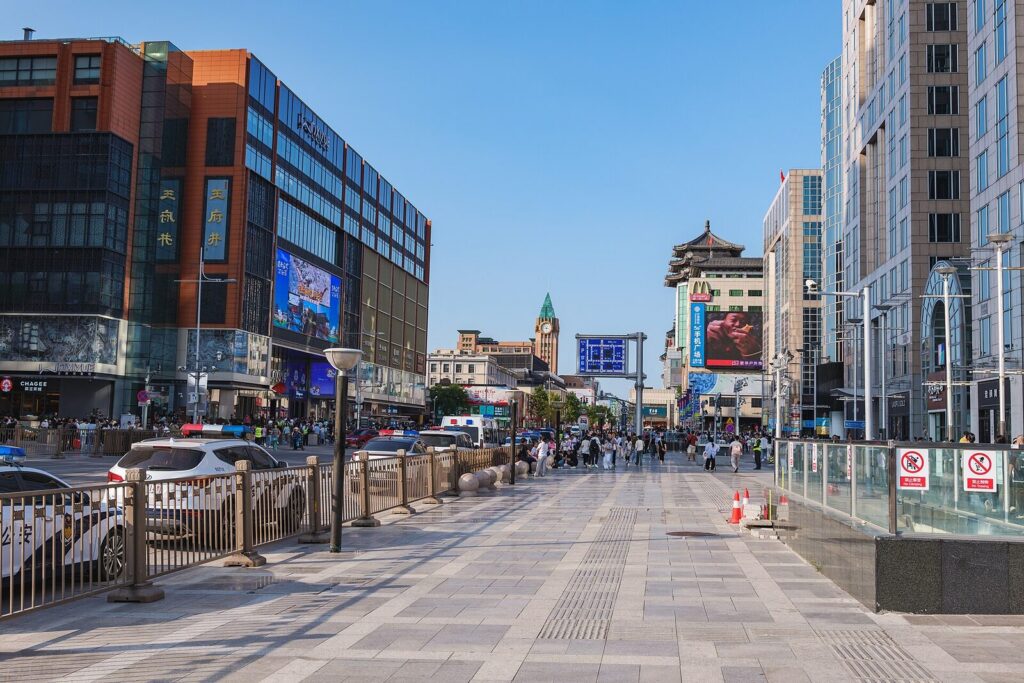
Wangfujing is Beijing’s best-known shopping street, a wide pedestrian strip of department stores and restaurants a short walk east of the Forbidden City. The streets around it hold the city’s biggest concentration of international hotels, and that matters for a first visit: English-speaking front desks, foreign-card payment terminals and staff who register a foreign passport without hesitation. Our 3-day Beijing plan is built around this base for exactly that reason.
The metro connections are the best in the city: Wangfujing station serves Lines 1 and 8, Dongdan serves Lines 1 and 5. The Forbidden City is about 1.3 km away — one stop or a 15-minute walk — and the Temple of Heaven, Lama Temple and Summer Palace are all reachable without changing lines more than once. The trade-off is character and cost. This is a district of department stores and chain hotels, not old Beijing, and the streets empty once the shops close. Mid-range rooms typically run ¥600–1,200 a night, five-star hotels above ¥2,000, and budget travellers will find little under ¥400. If your budget is flexible and your trip is short, this is still the right call — you are paying for time, not luxury.
The hutongs: courtyard hotels in the old lanes
The hutongs are Beijing’s old alleys of grey-brick courtyard houses, and the best-known stretch runs from Nanluoguxiang past the Drum and Bell Towers to the lakes at Shichahai. Staying here means stepping out into lanes of small cafes, dumpling shops and bicycle bells instead of a shopping mall — the closest thing to sleeping inside old Beijing.
The practical base is around Gulou (Drum Tower) and Shichahai, served by Lines 2, 6 and 8. The Forbidden City is roughly 2–2.7 km away, a pleasant cycle ride or a 10-minute metro trip. But choose carefully: courtyard hotels vary enormously, from restored boutique stays to thin-walled rooms with no lift and a shared courtyard bathroom. Taxis usually cannot reach the front door, so you will walk the last 100 metres with your bags over stone paving. Book a property with recent reviews from foreign guests, and check the listing’s photos for a private bathroom rather than assuming one exists. Prices run roughly ¥400–1,500 a night, with chain hotels the safer bet among the many small courtyard properties.
Qianmen and Dashilar: good value south of Tiananmen
Qianmen is the old gate at the south end of Tiananmen Square, and behind it Dashilar is a restored shopping street lined with small hotels and hostels. Rooms here often cost ¥100–300 less per night than equivalent rooms in Wangfujing, and you can walk to Tiananmen Square before the crowds arrive.
Qianmen station serves Lines 2 and 8, and the Temple of Heaven is a 25-minute walk south or one stop away — read our Temple of Heaven guide for the route and ticket details. The Forbidden City entrance is about 1.5 km north. The trade-off is atmosphere after dark: Dashilar is lively by day and quiet at night, and souvenir shops outnumber local life. Book a hotel on a main lane rather than deep inside an alley, and check for a lift if you carry heavy bags.
Sanlitun and Guomao: for food, nightlife and modern Beijing
Sanlitun is Beijing’s international district: restaurants from everywhere, bars, embassies and the Taikoo Li shopping centre. Guomao, one metro interchange to the south, is the central business district, all glass towers and five-star hotels. Together they are the best base for eating out late, for business travel and for anyone staying a week or more.
The metro works well — Tuanjiehu and Workers’ Stadium serve Sanlitun, Guomao is a Lines 1 and 10 interchange — but the heritage sights are a longer trip. The Forbidden City or Qianmen commonly takes 35–55 minutes including the final walk, so this base costs you an hour a day if your trip is mostly sightseeing. The compensation is the airport: the Capital Airport Express reaches Dongzhimen and Sanyuanqiao, both a short ride from Sanlitun. See our airport arrival guide for the full routes from both Beijing airports. Choose Sanlitun for nightlife, Guomao for business — neither suits a two-night first visit.
What a night costs in Beijing
As a rough guide outside peak holidays: a dorm bed ¥150–280, a clean budget-chain private room ¥250–400, a comfortable mid-range room ¥400–1,000, a good four-star room ¥800–1,500, and a five-star room from about ¥2,000. Prices swing with the season — during Golden Week in October 2026 the popular areas filled early and prices rose; from November to March the same streets are far quieter and cheaper. Book early for weekends and holidays, and check whether breakfast is included: a ¥50 breakfast for two adds up over four nights.
Can foreigners stay anywhere? The rules for 2026
Yes. Since July 2024, a joint notice from seven national departments — including the Ministry of Commerce, the Ministry of Public Security and the National Immigration Administration — has said that no hotel may refuse a foreign guest for lacking a “foreign-guest qualification”, and booking platforms may not advertise that a hotel does not accept foreigners. That old qualification system, a hangover from the 1980s, no longer exists.
At check-in, show your physical passport — photos and copies are not accepted — and the hotel registers your stay with the police for you. You only handle registration yourself if you sleep somewhere that is not a hotel, such as a friend’s flat, in which case you or your host must register within 24 hours of arrival. Refusals still happen, most often at small budget hotels whose staff have never registered a foreign passport. Ask for the manager or call the National Immigration Administration’s 12367 hotline, which answers in English around the clock. The simplest protection is to book on Trip.com and filter for listings that state guests from all countries and regions are welcome.
Practical tips before you book
- Check the metro walk, not just the station. A hotel “near Line 1” can still be a 15-minute walk from the platform. Measure the walk from the hotel door to the station entrance on a map.
- Book the Forbidden City before the hotel. Tickets are timed-entry, booked with your passport, and sell out days ahead in peak season — choose your dates around a ticket slot. See our attraction tickets guide.
- Check the bed size. A Chinese “double bed” is often 1.5 metres wide. If two adults are sharing, look for a 1.8-metre bed or a twin room.
- Keep the hotel’s Chinese name and address on your phone. Show it to taxi drivers — English names are rarely recognised, and the Chinese address is what gets you home at midnight. Airport hotels are for one night only: both airports are an hour from the centre, so a mid-trip airport stay wastes a day.
What to avoid
Avoid hotels outside the Third Ring Road unless you have a specific reason to be there — the savings are real, but so is the extra hour on the metro every day. Be wary of listings that advertise themselves as “near the Great Wall”: the nearest sections are 70 km from the centre, and a hotel there is a day trip, not a base. And skip the cheapest rooms in the hutongs with no recent foreign-guest reviews — a ¥200 courtyard room with a shared bathroom and no English at the desk is a false economy on a first trip.
Beijing rewards the traveller who chooses a base and sticks to it — one hotel for the whole stay beats moving every two nights. Pick the area that matches your trip — Wangfujing for a first visit, the hutongs for atmosphere, Qianmen for value — and the city does the rest.
Want this matched to your dates and budget? Our Route Design ($180) turns it into a day-by-day plan with the right base in each city, timed around your tickets and flights. And if you would rather hand over the whole trip, our Full Concierge ($480) handles the hotels, transport and bookings for you.