
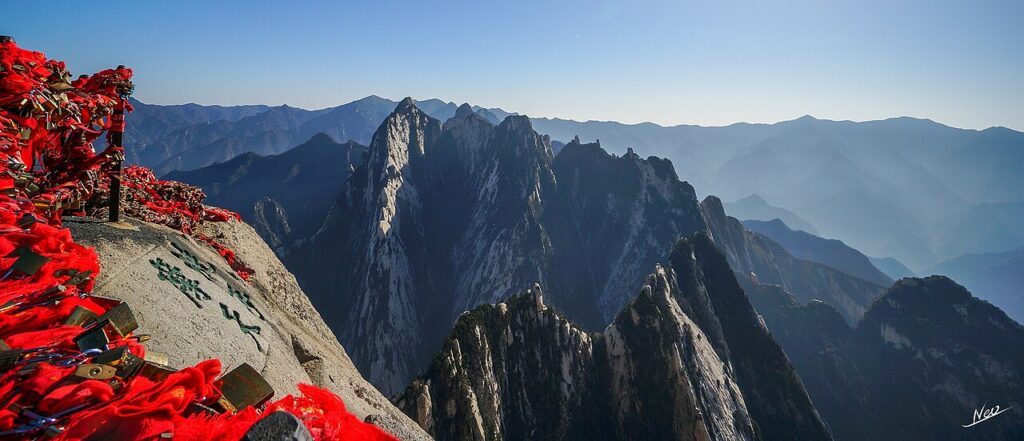
Shaanxi · Huayin
Rising sheer from the plains east of Xi’an, Mount Hua is the western peak of China’s Five Great Mountains — and the most dramatic of them all. Granite cliffs climb to 2,154.9 metres at the South Peak, linked by stone stairways cut into the rock, iron chains and narrow ridges between five distinct summits. This is a sacred Taoist mountain as much as a hiker’s challenge: temples and hermitages perch on ledges where monks have sought seclusion for centuries, and the air carries incense as often as pine. The mountain’s fame rests partly on the Plank Walk in the Sky, a boardwalk bolted to a sheer cliff face near the South Peak — optional, harnessed, and genuinely thrilling — but the real reward is the ridge walk itself, with sea-of-clouds views rolling between knife-edge peaks. Spring (April–June) and autumn (September–November) bring the clearest skies and mildest air; many visitors climb through the night to watch sunrise break over the East Peak, a tradition centuries old.
Tips: Take the high-speed train from Xi’an North to Huashan North (about 30 minutes), then ride the West Peak cable car up and walk the ridge to the South and East peaks, descending by the North Peak cable car — allow 5–6 hours. Go on a weekday morning and avoid Chinese public holidays, when queues stretch for hours. Wear grippy shoes and gloves for the chains, and bring warm layers: the summits run much colder than the plain.
Photo: Neo / Wikimedia Commons (CC BY 3.0)