
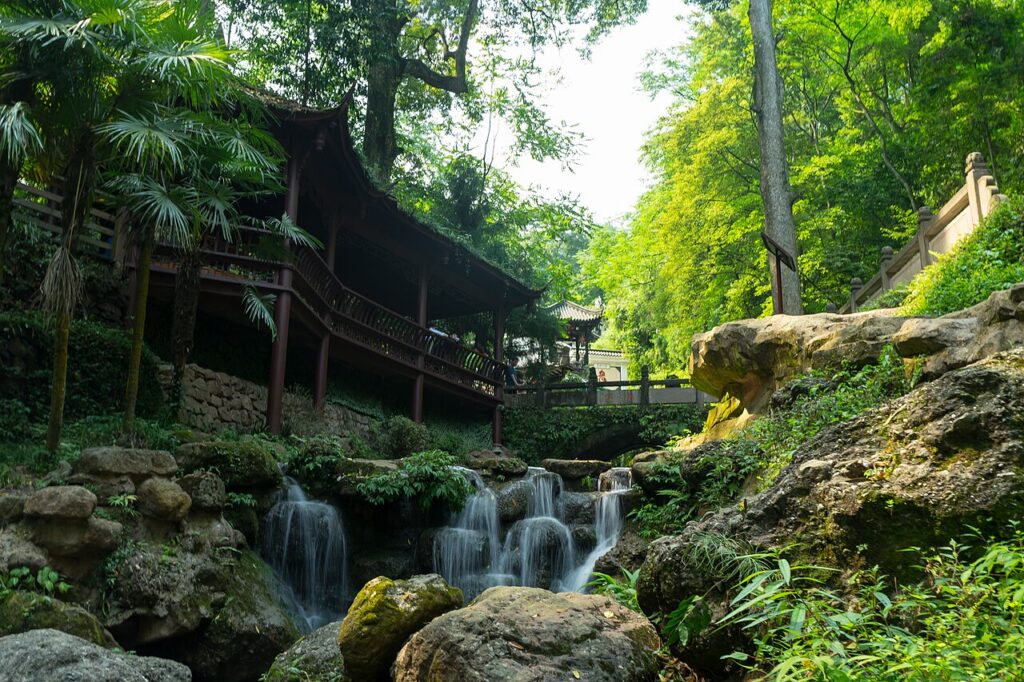
Sichuan · Dujiangyan
An hour from Chengdu, Mount Qingcheng is the quiet answer to Sichuan’s bigger, busier peaks. This is one of the birthplaces of Taoism — the teacher Zhang Daoling is said to have preached here in the second century — and the mountain still feels like a place built for slowing down: stone steps through dense, dripping forest, temples tucked into the mist, and streams running under every bridge. Inscribed on the UNESCO World Heritage List in 2000 together with the Dujiangyan Irrigation System, Qingcheng has two faces. The Front Mountain is the classic route, a climb past Jianfu Palace and Tianshi Cave to the summit’s Laojun Pavilion. The Back Mountain is wilder — waterfalls, bamboo groves, and cliff paths with far fewer people. Spring and autumn are the finest seasons, with mild air and clear views; summer is a cool escape from the Chengdu heat.
Tips: Start early — the morning mist is half the magic — and take the Front Mountain if you want temples and the classic climb, or the Back Mountain if you want quiet forest and waterfalls. Wear grippy shoes: the stone steps are often damp. Pair it with the Dujiangyan Irrigation System, 15 km away, for a full day that covers both halves of the UNESCO listing.
Photo: JianEn Yu / Wikimedia Commons (CC BY 2.0)